View methods side by side.
Choose up to four methods. Add them using the search and share the comparison by copying its link.
| Criterion |  Decision Making Decision Tree | 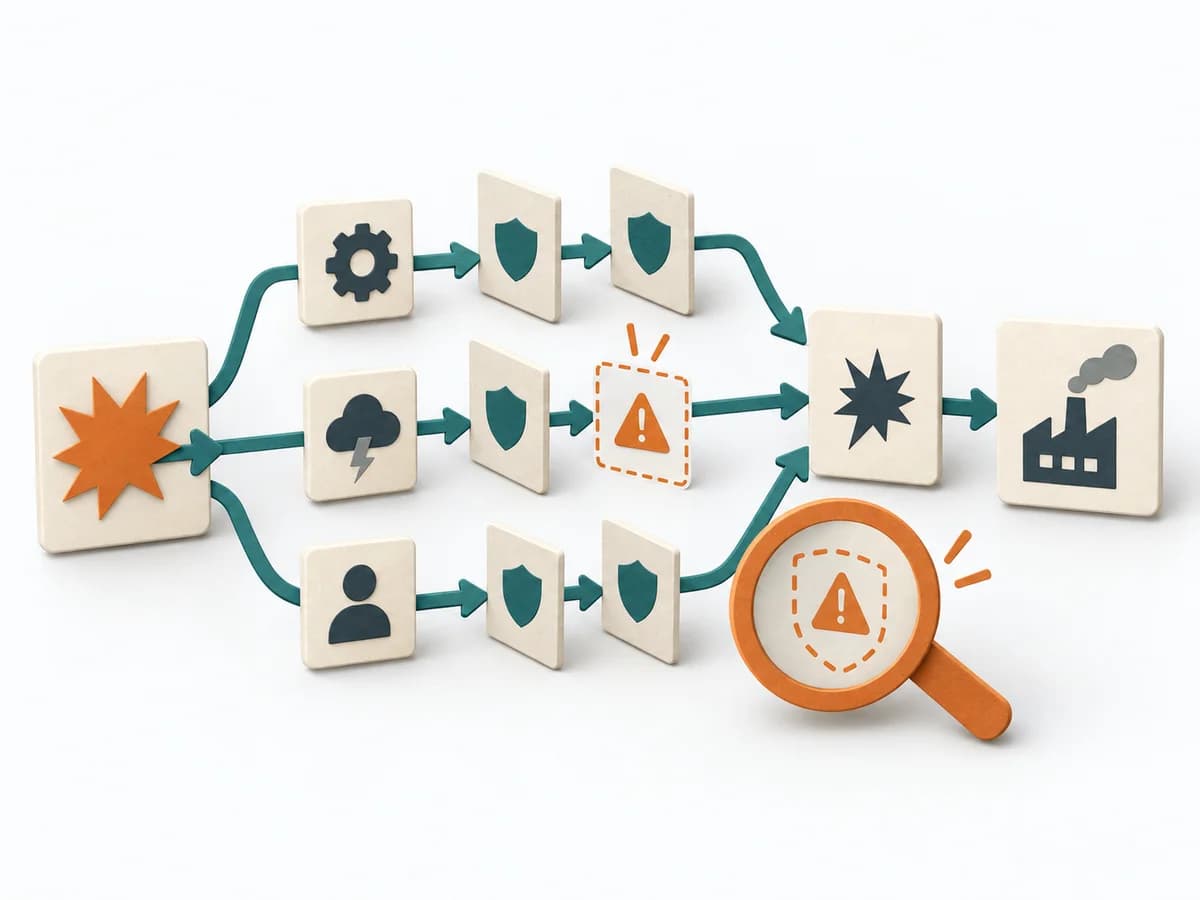 Engineering Failure Scenario Analysis |  Product Strategy DIBB |  Product Discovery Assumption Mapping |
|---|---|---|---|---|
Purposedifferent | For decisions with follow-on paths and dependencies, a linear comparison is often not enough. A Decision Tree shows how options branch under conditions and which consequences hang on each branch. | In critical processes, it is not enough to plan only for the normal case. Failure Scenario Analysis looks at the path into failure and shows which failures, chains, and control gaps cause the most damage. | DIBB helps clarify target groups, value, goals, and priorities by making the logic behind a decision explicit. It captures results as a DIBB document, belief list, bet list, and learning report. | When assumptions still sit unordered in the room, it weighs uncertainty against leverage. It makes visible which hypotheses should be checked first. |
Complexitydifferent | Medium | Medium | Low | Medium |
Timedifferent | 30-90 min | 1-3 h | 1-2 h | 45-60 min |
Participantsdifferent | 1-6 | 3-8 | 2-8 | 2-8 |
Formatdifferent | Workshop + async | Workshop | Workshop + async | Workshop + async |
Outputdifferent | Decision Tree, Option Map, Assumption List | Failure Scenarios, Risk Notes, Control Gaps, Test and Response Actions | DIBB document, Belief list, Bet list, Learning report | Assumption map, Test backlog, Risk ranking |
Tagsno overlap | DecisionTreeOptions | FailureResilienceRisk | StrategyDecisionAssumptionsHypothesis | AssumptionsRiskExperimentsValidation |