View methods side by side.
Choose up to four methods. Add them using the search and share the comparison by copying its link.
| Criterion |  Facilitation Decision Jam |  Product Strategy DIBB | 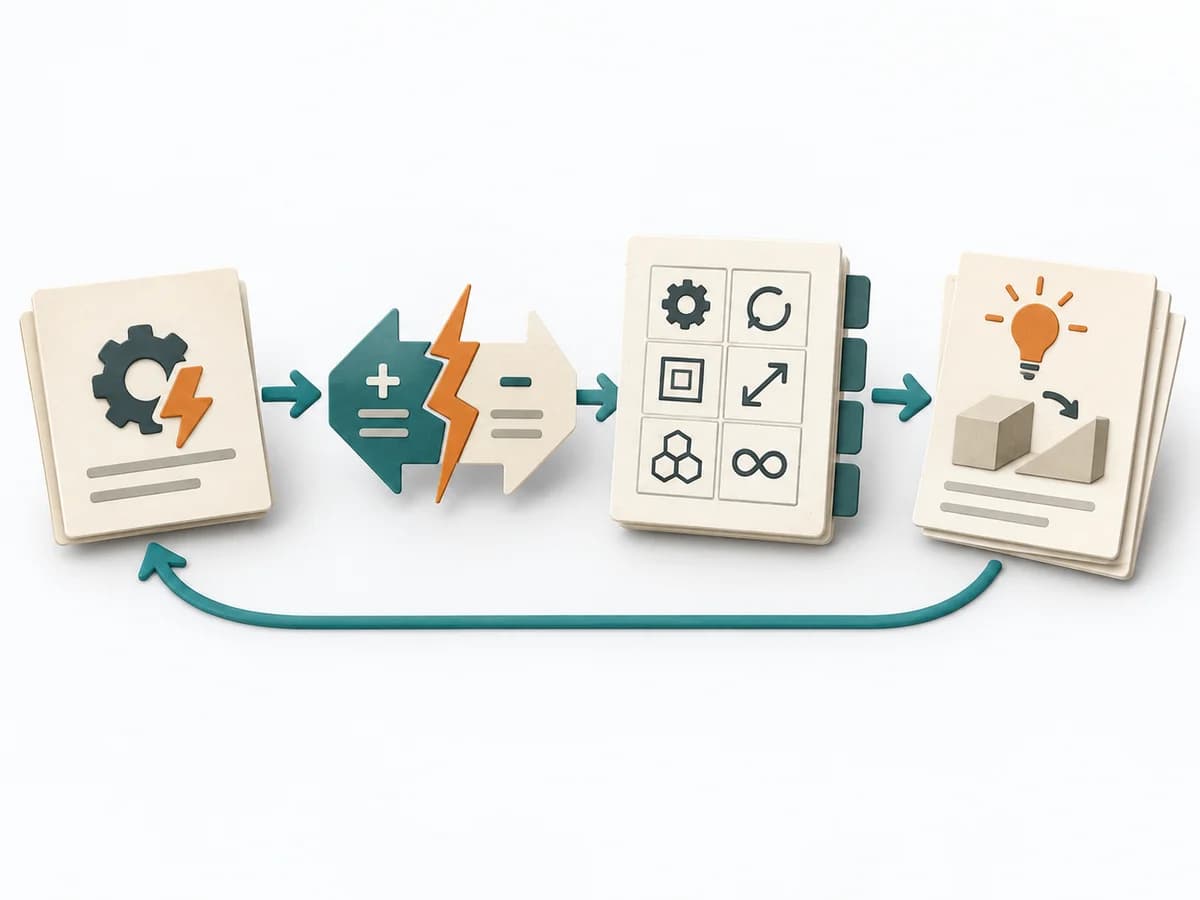 Innovation TRIZ |  Facilitation Alignment Mapping |
|---|---|---|---|---|
Purposedifferent | When a decision is stuck, Decision Jam loosens the knot through structured separation of problem, idea, and selection. The format creates movement without jumping prematurely at the first seemingly elegant answer. | DIBB helps clarify target groups, value, goals, and priorities by making the logic behind a decision explicit. It captures results as a DIBB document, belief list, bet list, and learning report. | For technical contradictions or trade-offs, the method looks for solutions that resolve opposing requirements at the same time. It translates limits into an explicit picture of conflict that becomes workable. This produces not just compromises but more elegant principles. | When several people work toward one goal but hold different mental maps, Alignment Mapping makes the discrepancies visible. It arranges goals, assumptions, and priorities so shared direction becomes verifiable. |
Complexitydifferent | Low | Low | High | Medium |
Timedifferent | 60-90 min | 1-2 h | 1-4 h | 1-2 h |
Participantsdifferent | 4-10 | 2-8 | 2-8 | 4-12 |
Formatdifferent | Workshop | Workshop + async | Workshop + async | Workshop |
Outputdifferent | Problem Cluster, Prioritized Challenge, Experiment | DIBB document, Belief list, Bet list, Learning report | Contradiction Statement, Inventive Principles, Solution Concepts | Alignment Map, Open Issues, Decision Questions |
Tagsno overlap | FacilitationDecisionProblem solvingWorkshop | StrategyDecisionAssumptionsHypothesis | InnovationProblem solvingContradictionsCreativity | AlignmentStakeholdersStrategyFacilitation |