View methods side by side.
Choose up to four methods. Add them using the search and share the comparison by copying its link.
| Criterion |  Domain Modeling Context Map | 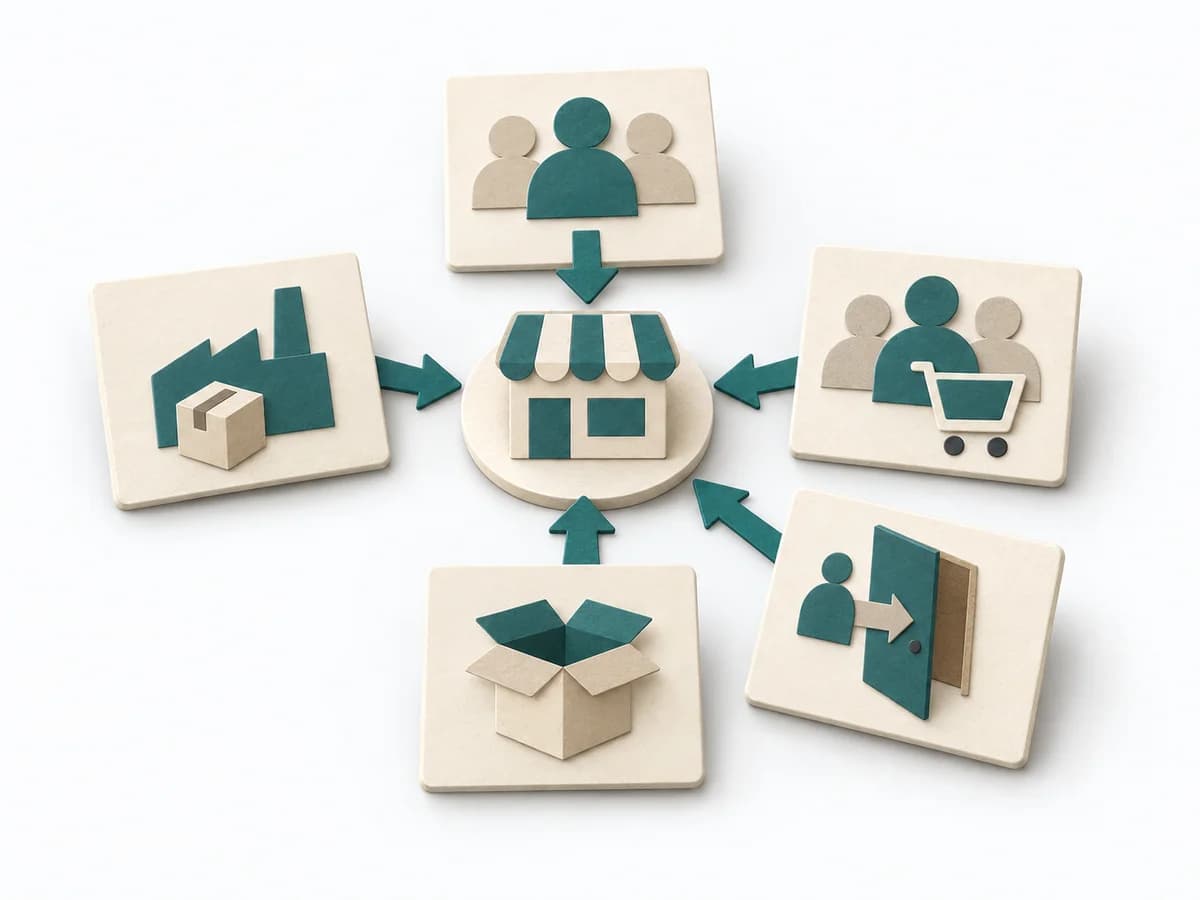 Business Strategy Porter Five Forces |  Domain Modeling Bounded Context Canvas |  Business Strategy PESTLE Analysis |
|---|---|---|---|---|
Purposedifferent | When several contexts need to talk to each other, it makes their relationships and dependencies legible. It helps sort integration pressure and responsibilities across system boundaries. | Porter Five Forces analyzes the forces that shape competitive pressure and profitability in a market. The view of market structure goes beyond individual competitors and reveals systemic pressure points. | When a business context is still loosely outlined, it shapes language, responsibility, and integration space. It clarifies what belongs together and where a boundary needs to hold. | PESTLE Analysis makes political, economic, social, technological, legal, and environmental influences visible. The environment of an initiative is thereby read systematically instead of through isolated trends. |
Complexitysame | Medium | Medium | Medium | Medium |
Timesame | 1-3 h | 1-3 h | 1-3 h | 1-3 h |
Participantsdifferent | 2-8 | 2-8 | 3-8 | 2-10 |
Formatsame | Workshop + async | Workshop + async | Workshop + async | Workshop + async |
Outputdifferent | Context Map, Integration Patterns, Boundary Notes | Five Forces Analysis, Competitive Risks, Strategic Options | Context Canvas, Glossary, Integration Notes | PESTLE Map, External Risks, Strategic Questions |
Tagsno overlap | Domain-Driven DesignBoundariesStrategy | StrategyCompetitionMarket | Domain-Driven DesignBoundariesModeling | StrategyMarketAnalysis |