View methods side by side.
Choose up to four methods. Add them using the search and share the comparison by copying its link.
| Criterion |  Product Discovery Context Canvas | 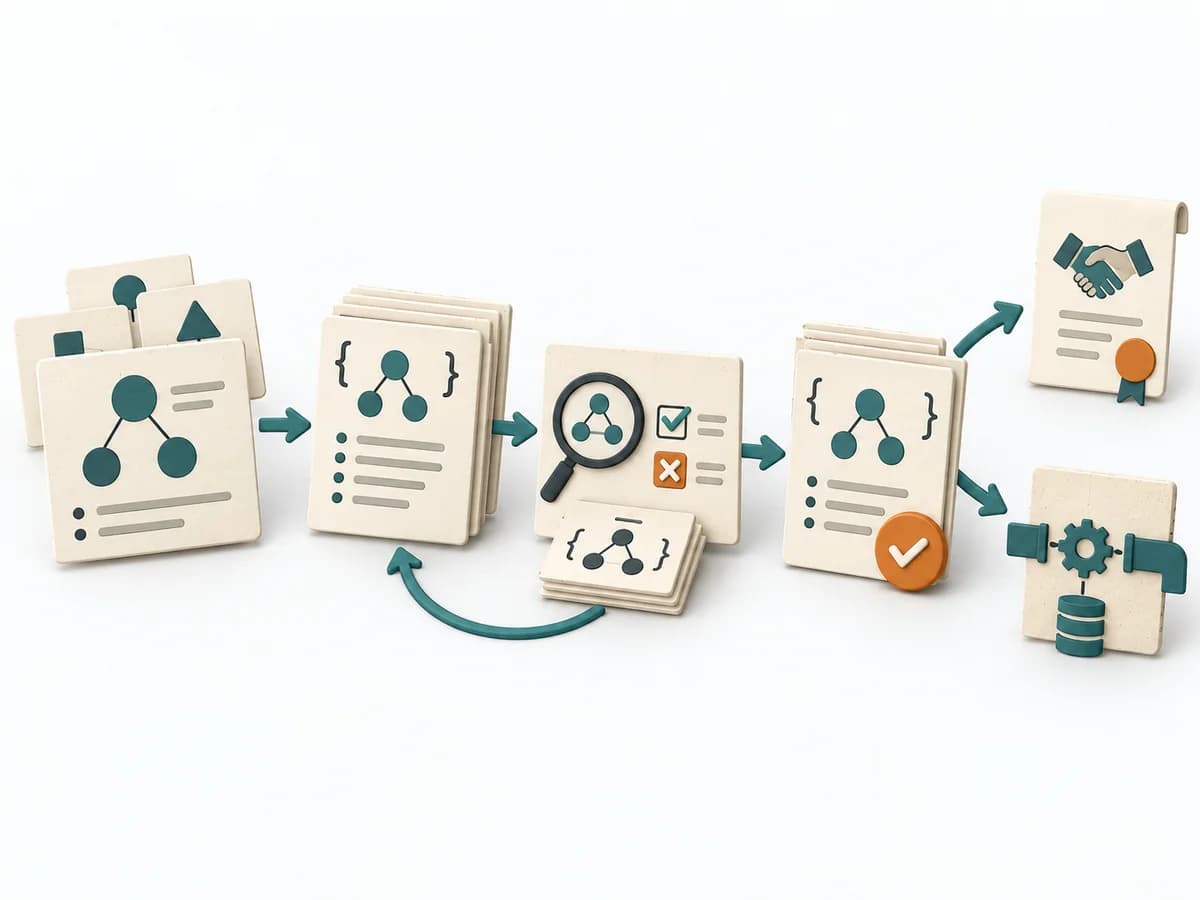 Knowledge Modeling Shape-First Modeling |  Product Discovery Smoke Test |  Growth A/B Testing |
|---|---|---|---|---|
Purposedifferent | When an environment of users, systems, and constraints is hard to grasp, it puts the context compactly on the table. It creates a clear reading of influence, boundary, and dependency. | Shape-First Modeling defines data quality through shapes before implementation or integration frays at the edges. The approach fits when validation and data contracts should be part of the design from the start. | When demand only needs to be roughly verified, it tests interest with minimal effort. It measures whether people would take a next step at all. | When two variants compete, discussions quickly decide by taste rather than effect. A/B Testing checks behavior under controlled conditions and separates real improvement from chance or expectation effects. |
Complexitydifferent | Low | Medium | Low | High |
Timedifferent | 45-90 min | Halber Tag pro Domain Slice | 1-5 Tage | 1-4 Wochen |
Participantsdifferent | 3-10 | 1-4 | Nutzertraffic | 1-6 |
Formatdifferent | Workshop | Workshop + async | Async | Async |
Outputdifferent | Context canvas, Open questions, Shared context notes | SHACL or ShEx Shapes, Validation Reports, Data Contracts, Shape Documentation | Interest Metrics, Conversion Signal, Learning Note | Experiment results, Decision log, Learning summary |
Tagsno overlap | ContextFramingRequirementsCanvas | Knowledge graphValidationSemantic | ValidationExperimentsDemandGrowth | ExperimentsGrowthAnalyticsValidation |