View methods side by side.
Choose up to four methods. Add them using the search and share the comparison by copying its link.
| Criterion |  Product Discovery Context Canvas |  Knowledge Modeling Shape-First Modeling |  Knowledge Modeling Ontology Design Patterns | 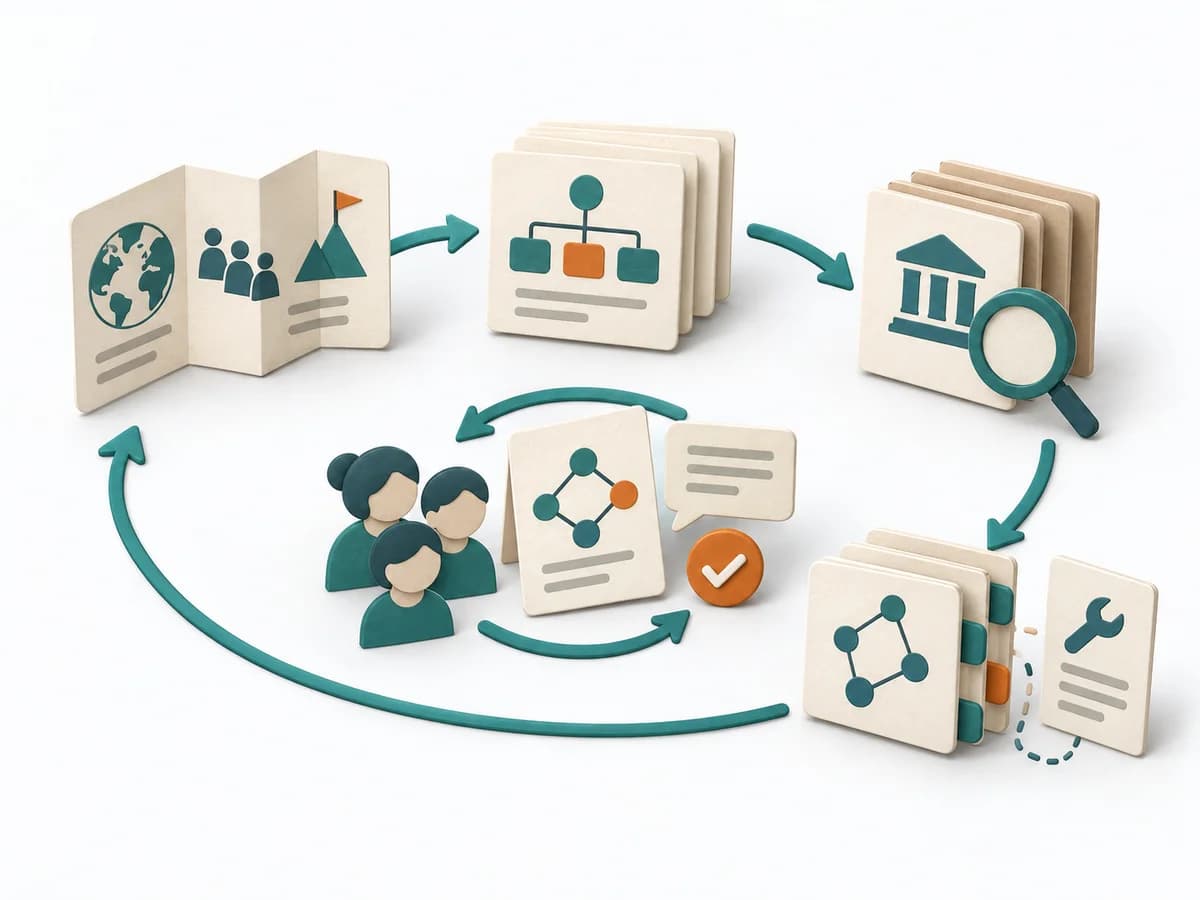 Knowledge Modeling NeOn Methodology |
|---|---|---|---|---|
Purposedifferent | When an environment of users, systems, and constraints is hard to grasp, it puts the context compactly on the table. It creates a clear reading of influence, boundary, and dependency. | Shape-First Modeling defines data quality through shapes before implementation or integration frays at the edges. The approach fits when validation and data contracts should be part of the design from the start. | Ontology Design Patterns provide reusable building blocks for recurring modeling problems. The method brings structure to the search for clean concepts, relationships, and roles. | The NeOn Methodology structures ontology work as a controlled process with reuse, scenarios, and reviews. It is useful when ontologies should not emerge ad hoc but modularly and reusably. |
Complexitydifferent | Low | Medium | Medium | High |
Timedifferent | 45-90 min | Halber Tag pro Domain Slice | 1-3 h pro Pattern | Mehrere Wochen bis Monate |
Participantsdifferent | 3-10 | 1-4 | 1-6 | 2-10 |
Formatdifferent | Workshop | Workshop + async | Workshop + async | Workshop + async |
Outputdifferent | Context canvas, Open questions, Shared context notes | SHACL or ShEx Shapes, Validation Reports, Data Contracts, Shape Documentation | Selected Patterns, Adapted Schema Fragments, Pattern Documentation | Ontology Requirements Specification, Reuse Plan, Ontology Modules, Evaluation Report |
Tagsno overlap | ContextFramingRequirementsCanvas | Knowledge graphValidationSemantic | OntologyPatternsReuseSemanticModeling | OntologyMethodologyReuseSemanticEngineering |