View methods side by side.
Choose up to four methods. Add them using the search and share the comparison by copying its link.
| Criterion |  Product Discovery Context Canvas |  Knowledge Modeling IBIS |  Facilitation Power Interest Grid | 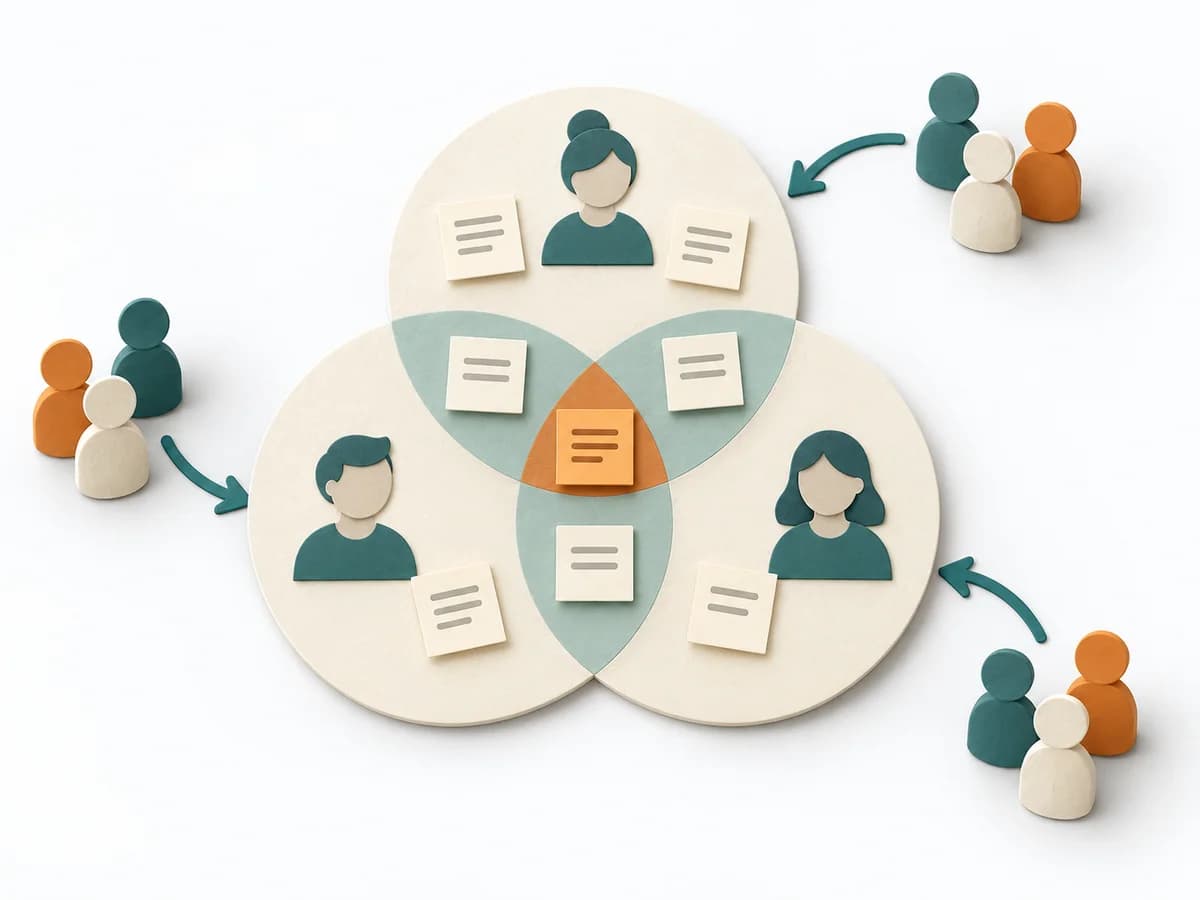 Facilitation 3-Circle Venn Diagram |
|---|---|---|---|---|
Purposedifferent | When an environment of users, systems, and constraints is hard to grasp, it puts the context compactly on the table. It creates a clear reading of influence, boundary, and dependency. | IBIS structures thinking about complex questions as a sequence of issues, ideas, and arguments. The method keeps discussions open without forcing them into premature consensus. | When many stakeholders compete for attention at once, the Power Interest Grid sorts them by influence and stake. It turns individual contributions into a visible selection. The result is captured as a Power Interest Grid and a stakeholder-specific strategy. | When three perspectives matter at the same time, a Three-Circle Venn Diagram shows the overlaps and remainders precisely. It makes visible where shared effect arises and where only a partial perspective applies. |
Complexitydifferent | Low | Medium | Low | Low |
Timedifferent | 45-90 min | 1-3 h | 30-60 min | 15-45 min |
Participantsdifferent | 3-10 | 2-8 | 2-8 | 2-8 |
Formatdifferent | Workshop | Workshop + async | Workshop | Workshop + async |
Outputdifferent | Context canvas, Open questions, Shared context notes | Issue Map, Positions, Argument Notes | Power Interest Grid, Strategy per Stakeholder | Venn Diagram, Overlap Notes, Differentiators |
Tagsno overlap | ContextFramingRequirementsCanvas | RationaleKnowledgeDecision | StakeholdersFacilitationAlignmentPlanning | ComparisonFacilitationAlignment |