View methods side by side.
Choose up to four methods. Add them using the search and share the comparison by copying its link.
| Criterion |  Decision Making Constraint Analysis | 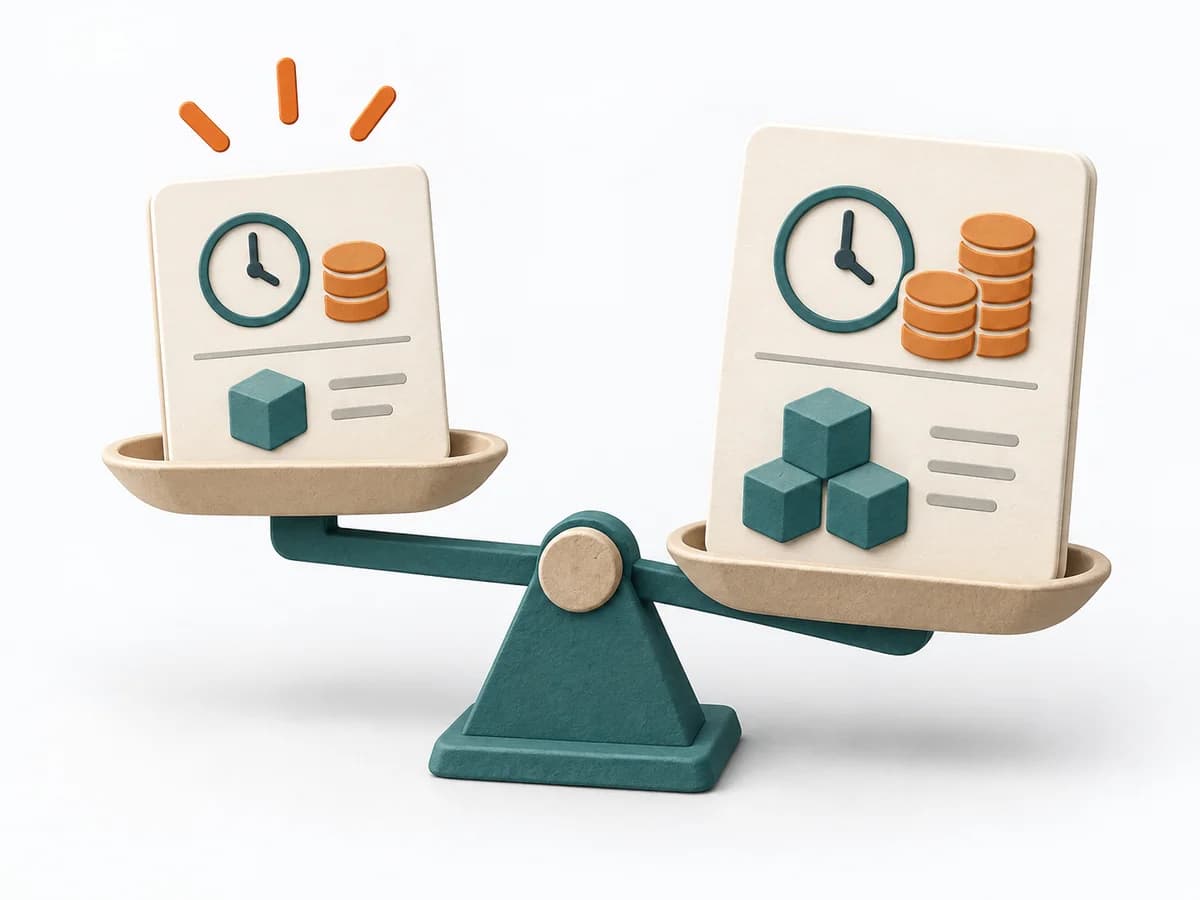 Agile WSJF |  Operations Gemba Walk |  Operations A3 Problem Solving |
|---|---|---|---|---|
Purposedifferent | When an initiative stalls, the limit often lies not in the idea but in hard or soft boundary conditions. Constraint Analysis separates these limits and shows which of them can actually be shaped. | When many tasks compete for the same capacity, it orders work by economic impact. It makes time lost, benefit, and effort comparable together. | When there is uncertainty about the real course of a process, the method brings observation to the place where work happens. It combines perception, follow-up questions, and process knowledge so decisions rest on actual workflows instead of assumptions. | For a complex deviation with several people involved, the method bundles problem, analysis, and decision onto one page. It creates a shared working space where causes, countermeasures, and follow-up fit together. |
Complexitydifferent | Low | High | Low | Medium |
Timedifferent | 30-90 min | 45-90 min | 30-120 min | 45-90 min |
Participantsdifferent | 2-8 | 3-10 | 2-6 | 2-5 |
Formatdifferent | Workshop + async | Workshop | Workshop | Workshop + async |
Outputdifferent | Constraint List, Hard/Soft Classification, Option Impact Notes, Decision Boundaries | Ranked Backlog, Cost-of-Delay Assumptions | Observation Notes, Improvement Ideas | A3 Report, Action Plan, Root Cause Analysis |
Tagsno overlap | ConstraintsDecisionPlanningOptions | LeanEconomicsSequencePrioritization | LeanObservationProcessOperations | LeanProblem solvingCoachingOperations |