View methods side by side.
Choose up to four methods. Add them using the search and share the comparison by copying its link.
| Criterion | 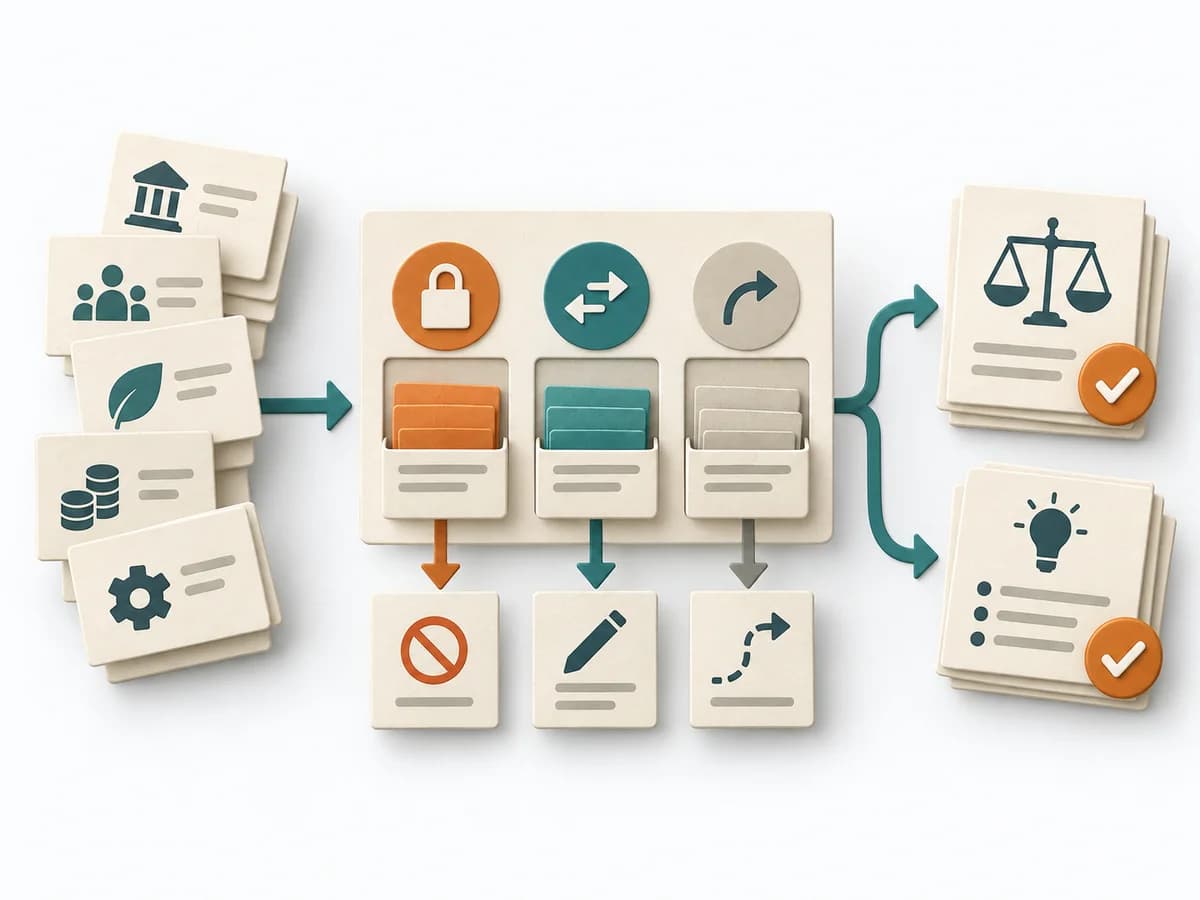 Decision Making Constraint Analysis |  Product Strategy DIBB |  Product Strategy Counter Metrics |  Product Discovery Assumption Mapping |
|---|---|---|---|---|
Purposedifferent | When an initiative stalls, the limit often lies not in the idea but in hard or soft boundary conditions. Constraint Analysis separates these limits and shows which of them can actually be shaped. | DIBB helps clarify target groups, value, goals, and priorities by making the logic behind a decision explicit. It captures results as a DIBB document, belief list, bet list, and learning report. | When a headline metric could mask side effects, it adds guardrail signals against unwanted outcomes. It connects customer value, product logic, and decision priorities. The result is captured as a counter-metric list and guardrail definitions. | When assumptions still sit unordered in the room, it weighs uncertainty against leverage. It makes visible which hypotheses should be checked first. |
Complexitydifferent | Low | Low | Low | Medium |
Timedifferent | 30-90 min | 1-2 h | 30-60 min | 45-60 min |
Participantsdifferent | 2-8 | 2-8 | 2-6 | 2-8 |
Formatsame | Workshop + async | Workshop + async | Workshop + async | Workshop + async |
Outputdifferent | Constraint List, Hard/Soft Classification, Option Impact Notes, Decision Boundaries | DIBB document, Belief list, Bet list, Learning report | Counter Metric List, Guardrail Definitions | Assumption map, Test backlog, Risk ranking |
Tagsno overlap | ConstraintsDecisionPlanningOptions | StrategyDecisionAssumptionsHypothesis | MetricsMeasurementStrategyExperiments | AssumptionsRiskExperimentsValidation |