View methods side by side.
Choose up to four methods. Add them using the search and share the comparison by copying its link.
| Criterion | 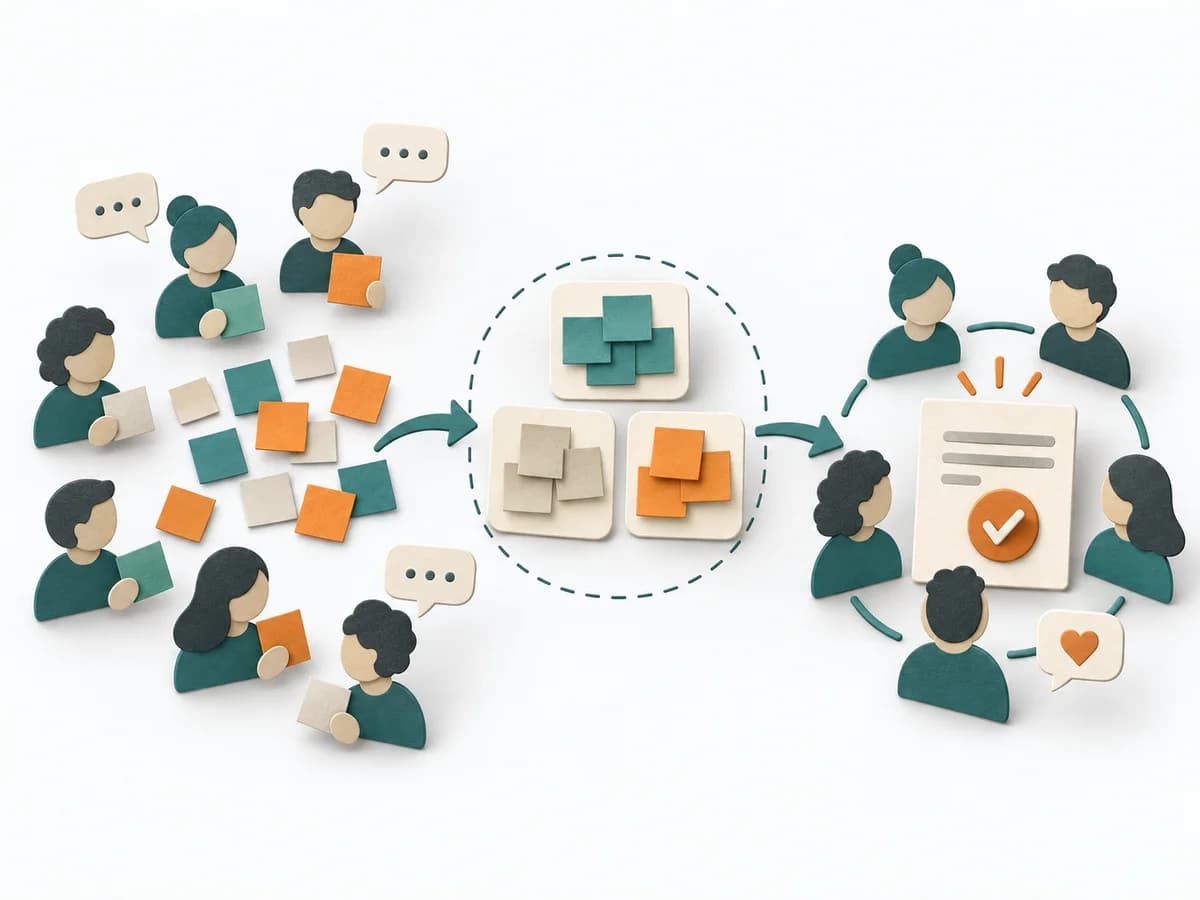 Facilitation Consensus Workshop |  Agile ROAM Board |  UX Research Affinity Diagramming |  Facilitation Decision Jam |
|---|---|---|---|---|
Purposedifferent | When a group needs a solid decision without outvoting individual factions, a Consensus Workshop creates a negotiable common ground. It makes agreement, reservations, and open tensions discussable at the same time. | When work needs to move between different states or columns, it makes that movement and its handoffs legible. It sorts work by value, risk, and delivery ability. The result is captured as a ROAM Board and an Owner List. | When research notes, feedback, or observations sit unconnected side by side, affinity diagramming sorts the raw material into solid themes. Many individual points turn into patterns that make decisions and opportunities clearer. | When a decision is stuck, Decision Jam loosens the knot through structured separation of problem, idea, and selection. The format creates movement without jumping prematurely at the first seemingly elegant answer. |
Complexitydifferent | Medium | Low | Low | Low |
Timedifferent | 1-3 h | 20-40 min initial, dann laufend | 45–90 min | 60-90 min |
Participantsdifferent | 5-30 | 3-15 | 3-10 | 4-10 |
Formatdifferent | Workshop | Workshop + async | Workshop | Workshop |
Outputdifferent | Consensus Clusters, Theme Titles, Priority Areas | ROAM Board, Owner List | Theme clusters, Insight statements, Opportunity areas | Problem Cluster, Prioritized Challenge, Experiment |
Tagsno overlap | FacilitationConsensusWorkshopAlignment | RiskAgileTrackingAlignment | SynthesisQualitativeRoot cause | FacilitationDecisionProblem solvingWorkshop |