View methods side by side.
Choose up to four methods. Add them using the search and share the comparison by copying its link.
| Criterion |  Knowledge Modeling Concept Mapping |  Operations Gemba Walk | 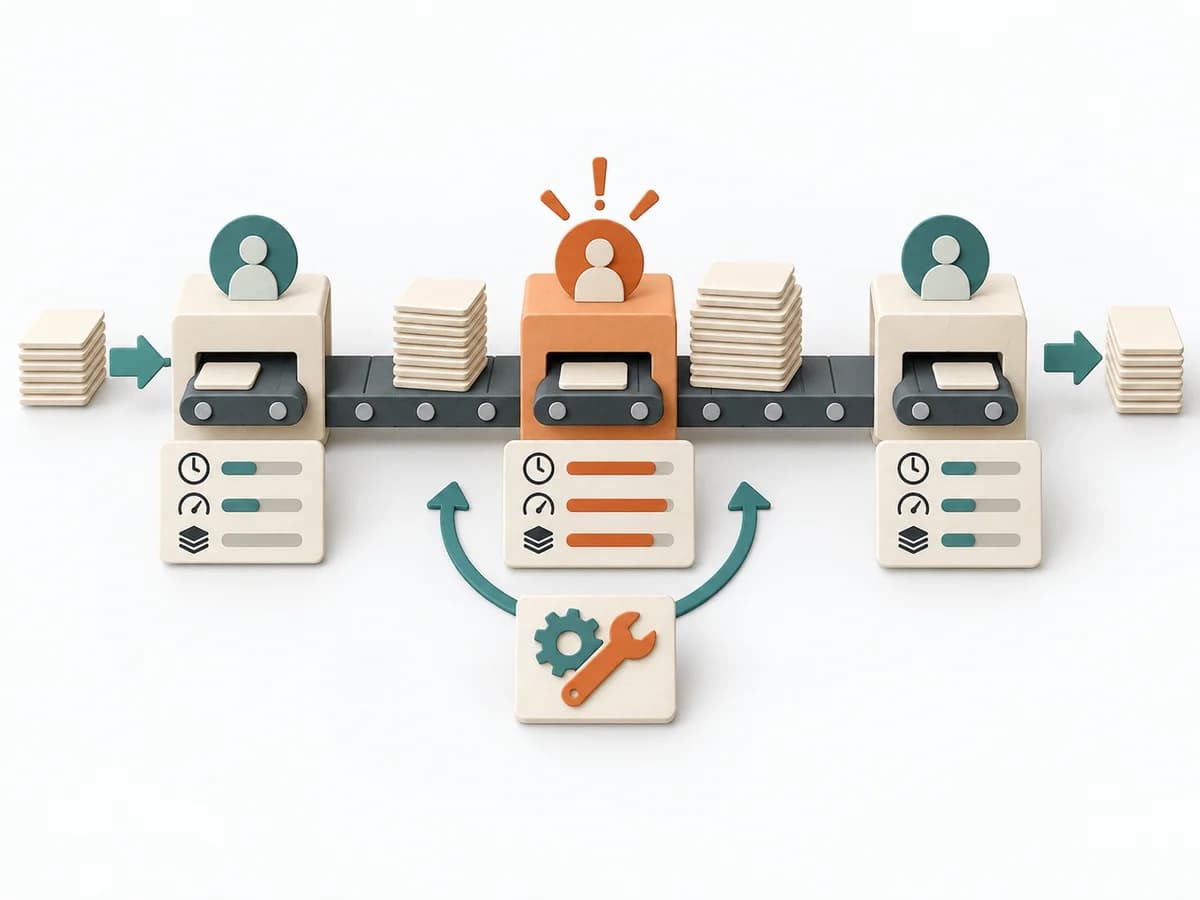 Operations Bottleneck Analysis |  Knowledge Modeling Domain Storytelling |
|---|---|---|---|---|
Purposedifferent | Concept Mapping arranges terms and relationships in a network that makes subject-matter connections tangible. It fits when a topic needs to be understood structurally rather than linearly. | When there is uncertainty about the real course of a process, the method brings observation to the place where work happens. It combines perception, follow-up questions, and process knowledge so decisions rest on actual workflows instead of assumptions. | For a flow that backs up at one point, the method looks for the capacity limit with the greatest leverage. It explains why extra effort elsewhere barely improves throughput. | Domain Storytelling translates domain knowledge into a shared narrative of actors, objects, and workflows. It is especially useful when language, rules, and process understanding must be tightly connected. |
Complexitydifferent | Medium | Low | Medium | Low |
Timedifferent | 1-2 h | 30-120 min | 1-3 h | 1-2 h |
Participantsdifferent | 1-8 | 2-6 | 3-8 | 2-8 |
Formatdifferent | Workshop + async | Workshop | Workshop + async | Workshop |
Outputdifferent | Concept Map, Relationship Labels, Knowledge Gaps | Observation Notes, Improvement Ideas | Bottleneck Map, Flow Metrics, Improvement Options, Follow-up Measures | Domain Story, Glossary Notes, Process Narrative |
Tagsno overlap | KnowledgeConceptsMappingSensemaking | LeanObservationProcessOperations | FlowMeasurementConstraints | KnowledgeDomain-Driven DesignProcess |