View methods side by side.
Choose up to four methods. Add them using the search and share the comparison by copying its link.
| Criterion |  Knowledge Modeling Concept Mapping | 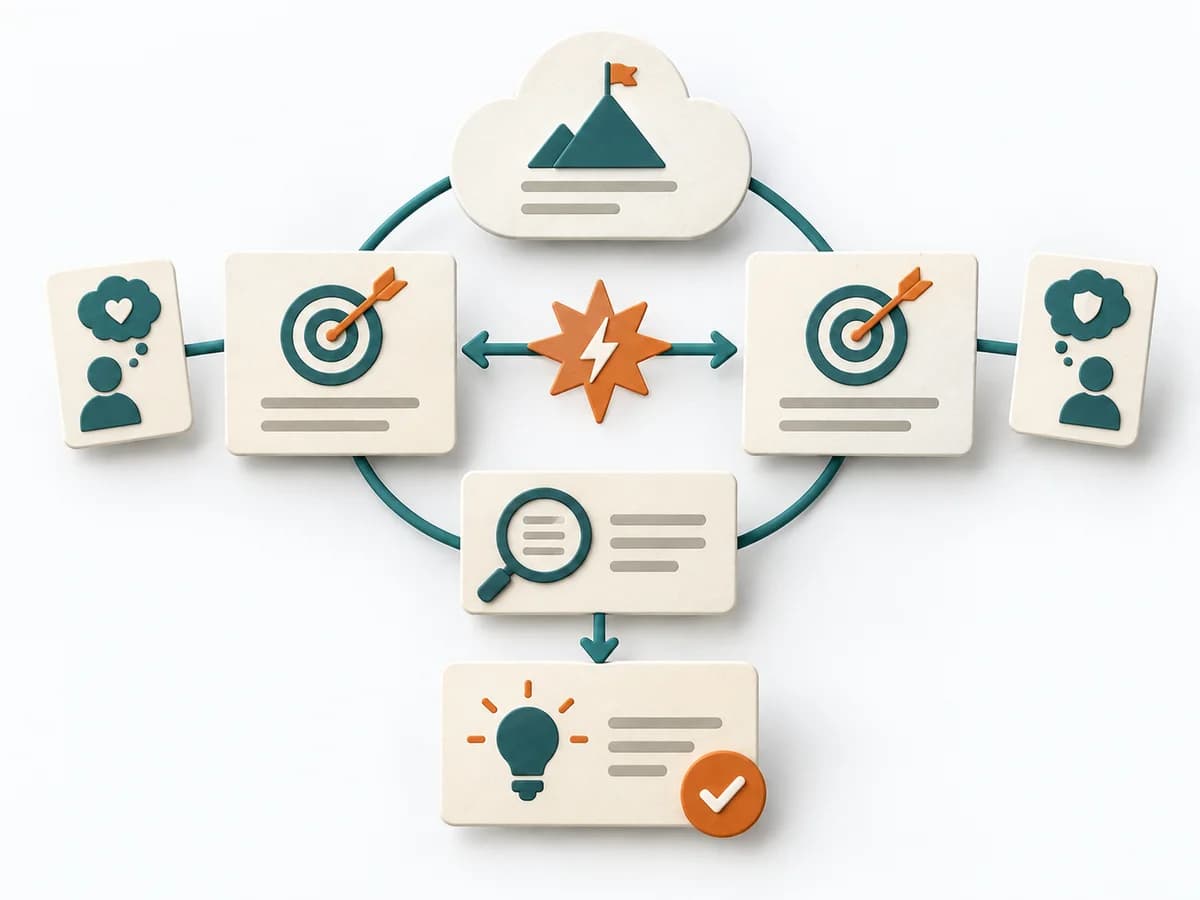 Systems Thinking Evaporating Cloud | 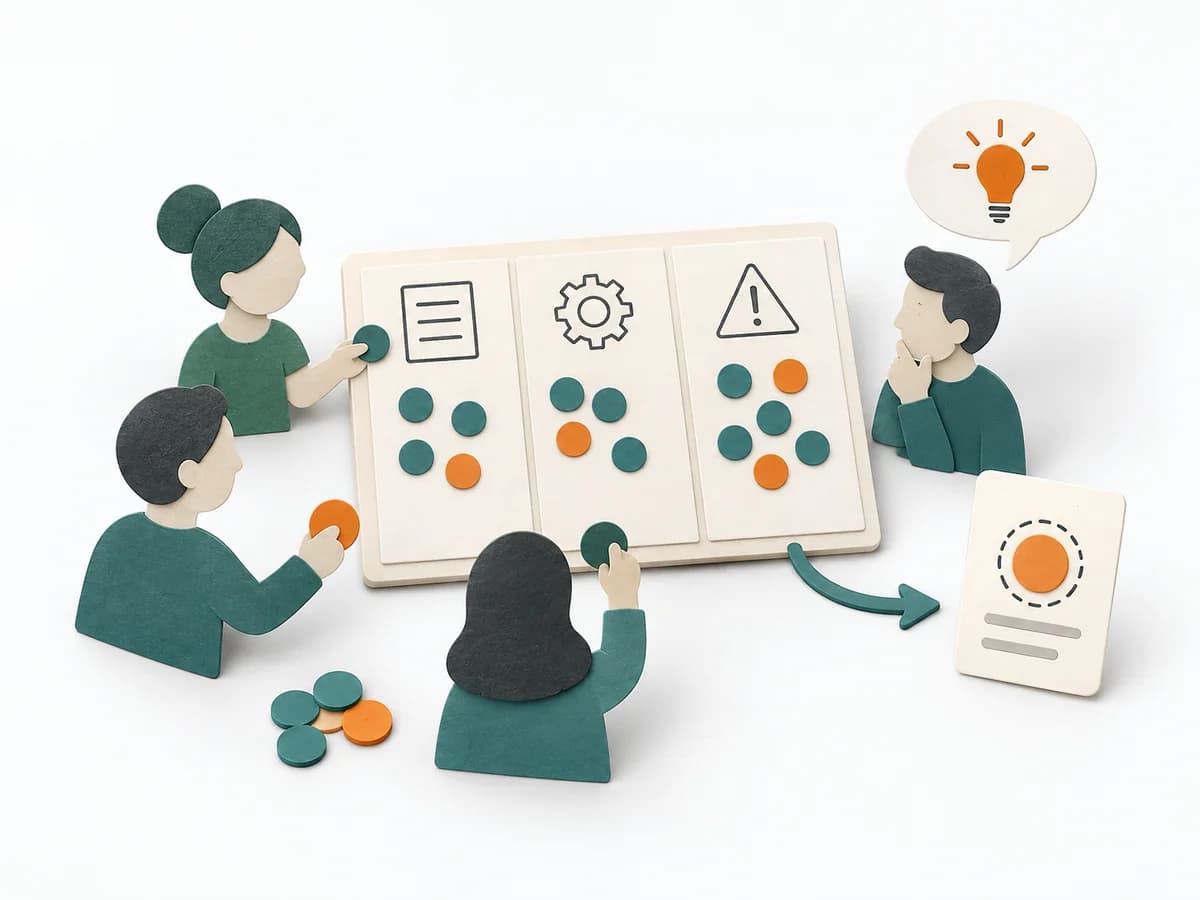 Facilitation Dot Estimation |  Product Discovery Assumption Mapping |
|---|---|---|---|---|
Purposedifferent | Concept Mapping arranges terms and relationships in a network that makes subject-matter connections tangible. It fits when a topic needs to be understood structurally rather than linearly. | The method makes visible why two seemingly incompatible demands arise and which assumption must be tested to resolve the conflict. | When size or effort can only be estimated roughly, Dot Estimation condenses the group's experience into a quick range. It turns individual contributions into a visible selection. The result is captured as an Effort Heatmap, Risk Signals, and Discussion Targets. | When assumptions still sit unordered in the room, it weighs uncertainty against leverage. It makes visible which hypotheses should be checked first. |
Complexitydifferent | Medium | Medium | Low | Medium |
Timedifferent | 1-2 h | 60-120 min | 5-20 min | 45-60 min |
Participantsdifferent | 1-8 | 2-8 | 3-20 | 2-8 |
Formatdifferent | Workshop + async | Workshop | Workshop | Workshop + async |
Outputdifferent | Concept Map, Relationship Labels, Knowledge Gaps | Conflict Cloud, Assumption List, Breakthrough Ideas, Next Experiments | Effort Heatmap, Risk Signals, Discussion Targets | Assumption map, Test backlog, Risk ranking |
Tagsno overlap | KnowledgeConceptsMappingSensemaking | Theory of ConstraintsAssumptionsSystems thinking | EstimationEffortRisk | AssumptionsRiskExperimentsValidation |