View methods side by side.
Choose up to four methods. Add them using the search and share the comparison by copying its link.
| Criterion |  UX Research Card Sorting |  Knowledge Modeling IBIS | 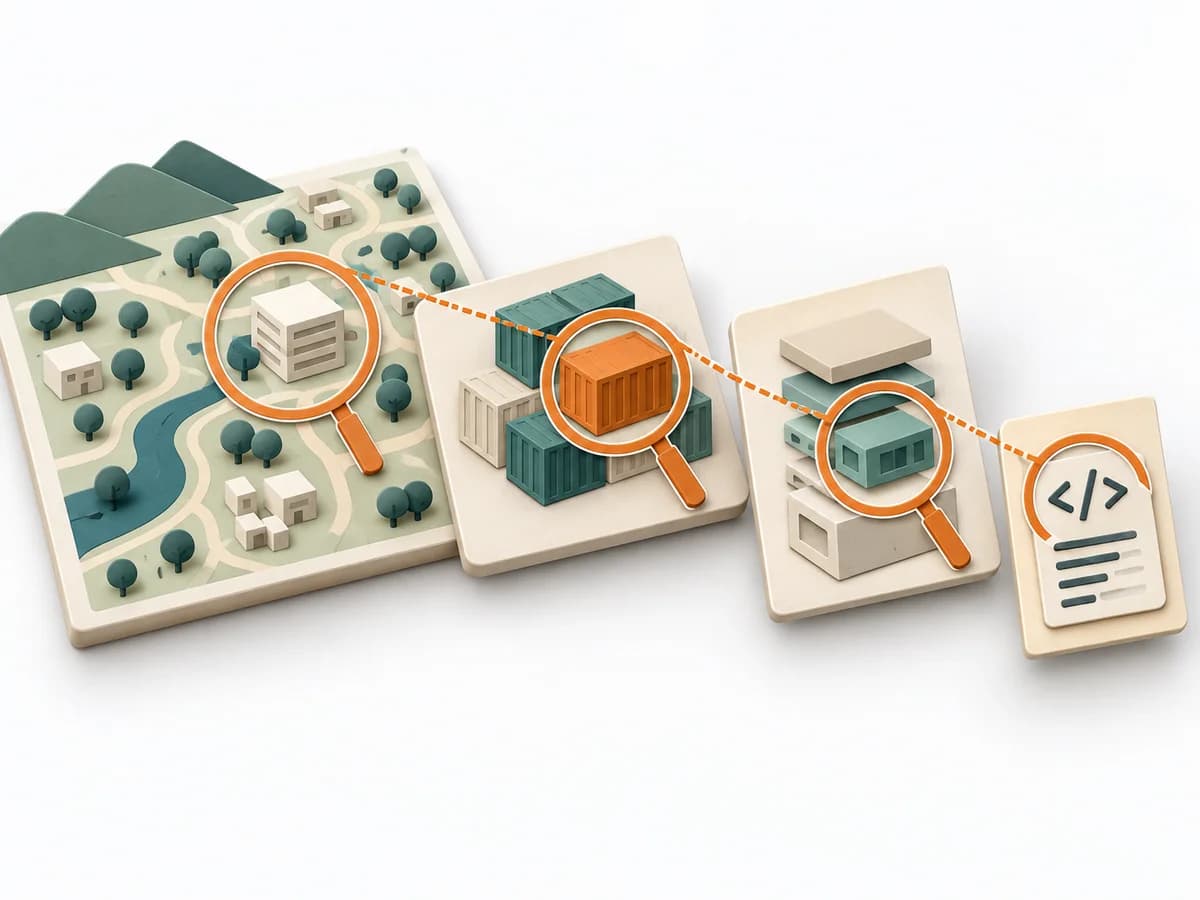 Architecture C4 Model |  Architecture Architecture Decision Record |
|---|---|---|---|---|
Purposedifferent | When content only makes sense internally and users can't find the structure again, card sorting exposes their mental order. Terms, groups, and naming are then aligned with the target group's expectations. | IBIS structures thinking about complex questions as a sequence of issues, ideas, and arguments. The method keeps discussions open without forcing them into premature consensus. | The C4 Model makes a system legible across several resolution levels, from context down to code. It suits situations where different audiences need to understand the same architecture from different altitudes. | An ADR permanently records an architecture decision with context, trade-offs, and consequence. It creates continuity for later changes because the decision path stays traceable. |
Complexitydifferent | Low | Medium | Low | Low |
Timedifferent | 20-45 min | 1-3 h | 1-4 h | 15-45 min |
Participantsdifferent | Based on research question | 2-8 | 1-5 | 1-3 |
Formatdifferent | Workshop + async | Workshop + async | Workshop + async | Async |
Outputdifferent | Content groups, Label set, IA hypotheses | Issue Map, Positions, Argument Notes | Context Diagram, Container Diagram, Component Diagram | ADR File, Decision Log, Rationale |
Tagsno overlap | Information architectureNavigationStructure | RationaleKnowledgeDecision | ArchitectureCommunicationVisualization | ArchitectureRationaleDocumentationGovernance |