View methods side by side.
Choose up to four methods. Add them using the search and share the comparison by copying its link.
| Criterion |  UX Research Card Sorting | 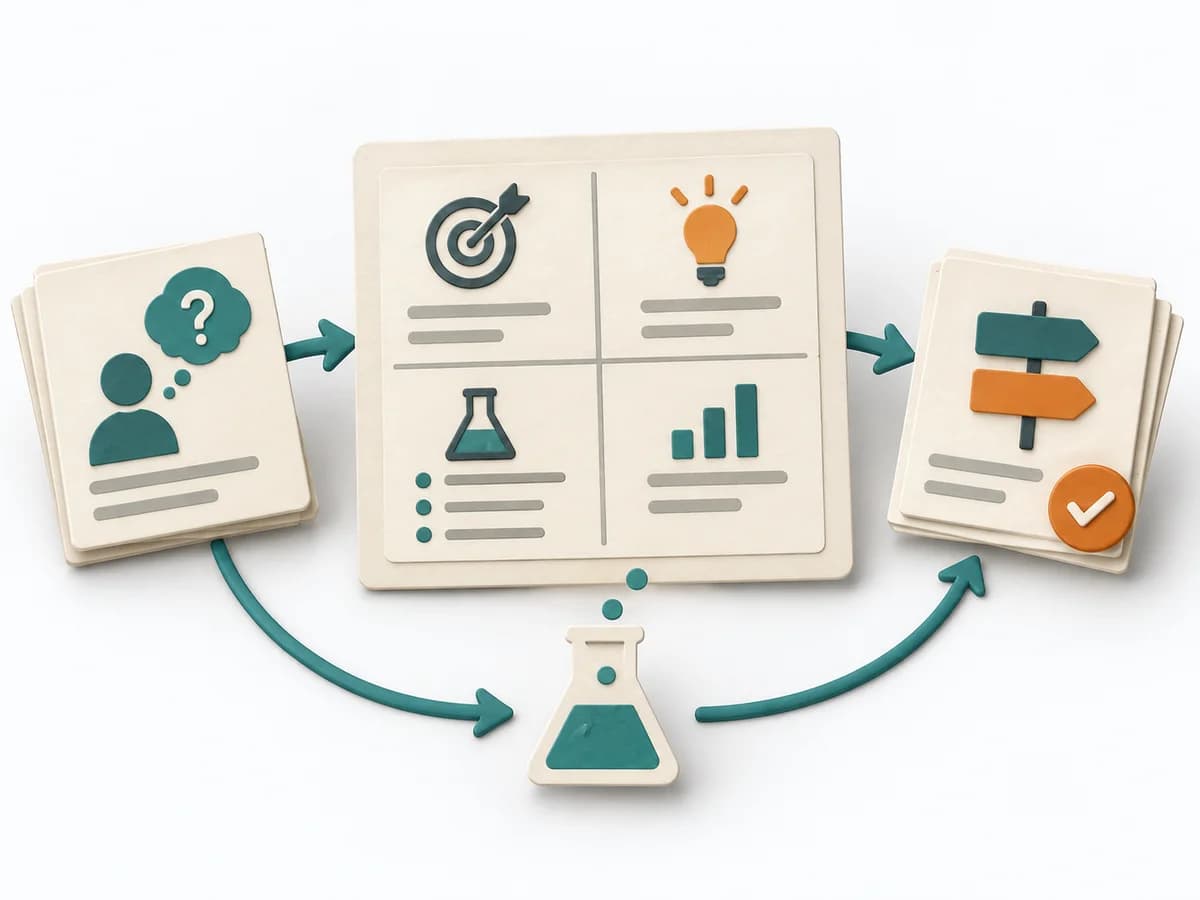 Product Discovery Experiment Canvas |  Product Strategy DIBB |  Product Discovery Riskiest Assumption Test |
|---|---|---|---|---|
Purposedifferent | When content only makes sense internally and users can't find the structure again, card sorting exposes their mental order. Terms, groups, and naming are then aligned with the target group's expectations. | When experiments become unreadable after the fact, it arranges hypothesis, signal, and learning goal on a single canvas. It separates problem, assumption, solution, and evidence. The result is captured as a Completed Experiment Canvas and a Success Metric. | DIBB helps clarify target groups, value, goals, and priorities by making the logic behind a decision explicit. It captures results as a DIBB document, belief list, bet list, and learning report. | When an idea hinges on one critical unknown, it prioritizes testing that exact piece of uncertainty first. It separates problem, assumption, solution, and evidence. The result is captured as a prioritized list of assumptions, a test plan, and a result report. |
Complexitydifferent | Low | Low | Low | Medium |
Timedifferent | 20-45 min | 30-60 min | 1-2 h | 1-2 Wochen pro Iteration |
Participantsdifferent | Based on research question | 1-5 | 2-8 | 2-6 |
Formatsame | Workshop + async | Workshop + async | Workshop + async | Workshop + async |
Outputdifferent | Content groups, Label set, IA hypotheses | Completed Experiment Canvas, Success Metric | DIBB document, Belief list, Bet list, Learning report | Prioritized Assumption List, Test Plan, Results Report |
Tagsno overlap | Information architectureNavigationStructure | ExperimentsValidationDiscoveryHypothesis | StrategyDecisionAssumptionsHypothesis | ExperimentsValidationDiscoveryAssumptions |