View methods side by side.
Choose up to four methods. Add them using the search and share the comparison by copying its link.
| Criterion |  UX Research Card Sorting |  Innovation Design Thinking |  Decision Making Delphi Method | 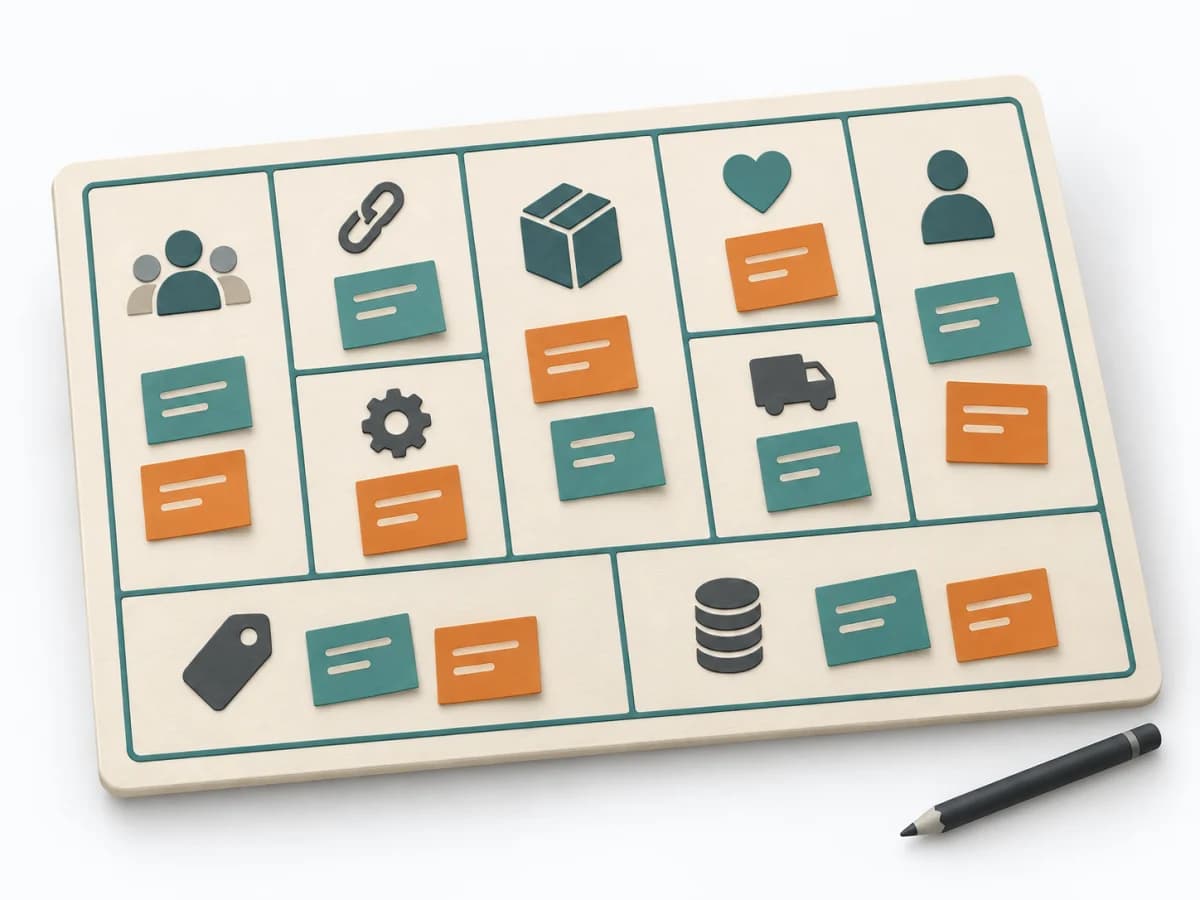 Business Strategy Business Model Canvas |
|---|---|---|---|---|
Purposedifferent | When content only makes sense internally and users can't find the structure again, card sorting exposes their mental order. Terms, groups, and naming are then aligned with the target group's expectations. | For complex user problems with an uncertain cause, the method connects observation, interpretation, and experiment into a learning cycle. It keeps the focus on real needs and avoids premature solution language. This produces robust decisions for product and service. | When knowledge is distributed and direct dominance should be avoided, groups quickly fall under the sway of their opinion leaders. The Delphi Method gathers assessments iteratively and gradually brings expert judgments closer together. | The Business Model Canvas condenses a business model to its key building blocks and assumptions. It makes variants quickly comparable and reveals gaps before validation or implementation begins. |
Complexitydifferent | Low | High | High | Medium |
Timedifferent | 20-45 min | 1 Tag bis mehrere Wochen | 1-4 Wochen | 1-2 h |
Participantsdifferent | Based on research question | 4-10 | 6-30 Experten | 2-8 |
Formatdifferent | Workshop + async | Workshop | Async | Workshop + async |
Outputdifferent | Content groups, Label set, IA hypotheses | Problem Statement, Prototype, Test Learnings | Expert Forecast, Consensus Range, Assumption Notes | Business Model Canvas, Assumption List, Business Hypotheses |
Tagsno overlap | Information architectureNavigationStructure | InnovationPrototypeResearch | ForecastingExpertsDecisionStrategy | Business modelStrategyValueInnovation |