View methods side by side.
Choose up to four methods. Add them using the search and share the comparison by copying its link.
| Criterion |  UX Research Card Sorting |  Decision Making Decision Tree |  Decision Making Assumption Surfacing | 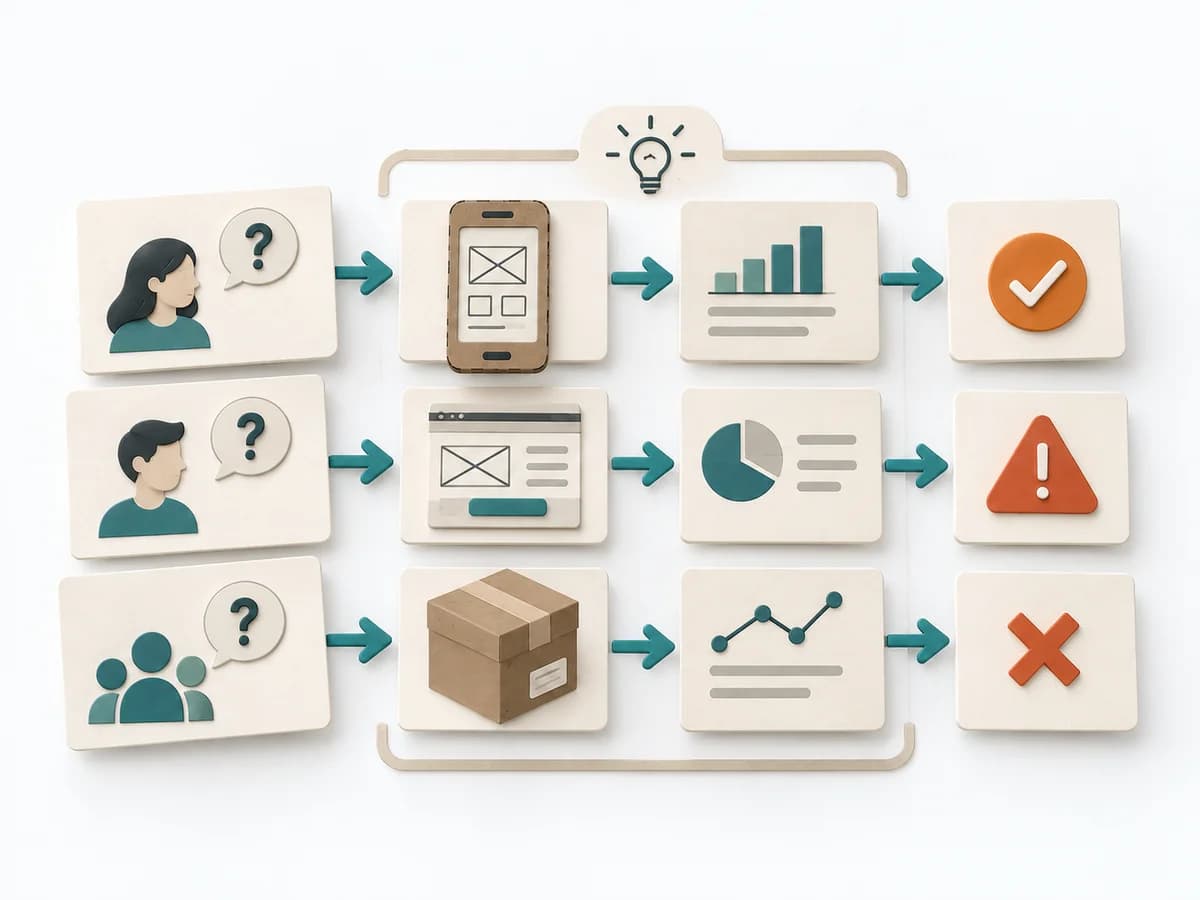 Product Discovery MVP Test Matrix |
|---|---|---|---|---|
Purposedifferent | When content only makes sense internally and users can't find the structure again, card sorting exposes their mental order. Terms, groups, and naming are then aligned with the target group's expectations. | For decisions with follow-on paths and dependencies, a linear comparison is often not enough. A Decision Tree shows how options branch under conditions and which consequences hang on each branch. | Plans often contain assumptions that were never openly stated and remain dangerous precisely because of that. Assumption Surfacing makes these silent premises visible and prioritizes which of them carry the initiative or could sink it. | When several minimal variants compete to answer the same question, it makes comparing and choosing between them cleaner. It separates problem, assumption, solution, and evidence. The result is captured as a Test Matrix and a Test Plan. |
Complexitydifferent | Low | Medium | Low | Medium |
Timedifferent | 20-45 min | 30-90 min | 45-90 min | 45-75 min |
Participantsdifferent | Based on research question | 1-6 | 2-8 | 2-8 |
Formatdifferent | Workshop + async | Workshop + async | Workshop + async | Workshop |
Outputdifferent | Content groups, Label set, IA hypotheses | Decision Tree, Option Map, Assumption List | Assumption List, Critical Assumptions, Learning Plan | Test Matrix, Test Plan |
Tagsno overlap | Information architectureNavigationStructure | DecisionTreeOptions | AssumptionsRiskDecisionDiscovery | ExperimentsValidationDiscoveryOptions |