View methods side by side.
Choose up to four methods. Add them using the search and share the comparison by copying its link.
Selected:C4 ModelStakeholder Salience ModelArchitecture Communication CanvasSoftware Architecture Canvas
| Criterion | 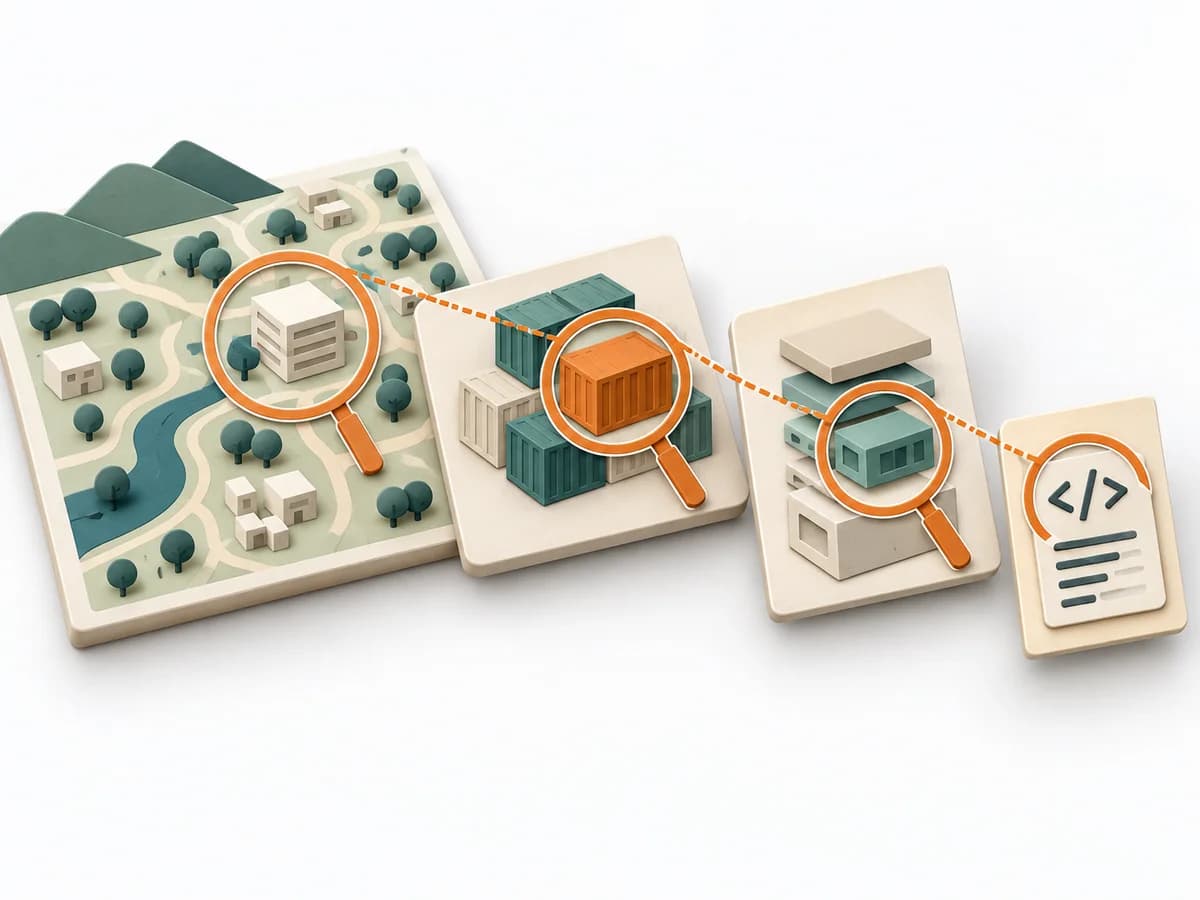 Architecture C4 Model |  Facilitation Stakeholder Salience Model |  Architecture Architecture Communication Canvas |  Architecture Software Architecture Canvas |
|---|---|---|---|---|
Purposedifferent | The C4 Model makes a system legible across several resolution levels, from context down to code. It suits situations where different audiences need to understand the same architecture from different altitudes. | When stakeholders appear to matter very differently, the Stakeholder Salience Model rates their actual priority through power, legitimacy, and urgency. It turns individual contributions into a visible selection. The result is captured as a Salience diagram and a class-based strategy. | The Architecture Communication Canvas plans architecture communication so the right people receive the right message. The method turns technical complexity into deliberate communication design. | The Software Architecture Canvas reduces a system to the most important architecture decisions, constraints, and interfaces. It is useful when teams need a resilient overall picture quickly. |
Complexitydifferent | Low | Medium | Medium | Low |
Timedifferent | 1-4 h | 60-90 min | 60-120 min | 1-2 h |
Participantsdifferent | 1-5 | 3-6 | 2-8 | 3-10 |
Formatdifferent | Workshop + async | Workshop | Workshop + async | Workshop |
Outputdifferent | Context Diagram, Container Diagram, Component Diagram | Salience Diagram, Strategy per Class | Communication Canvas, Stakeholder Messages, Architecture Communication Plan | Architecture Canvas, Goals, Constraints, Quality Attributes |
Tagsno overlap | ArchitectureCommunicationVisualization | StakeholdersFacilitationAlignmentGovernance | ArchitectureCommunicationStakeholdersCanvas | CanvasArchitectureAlignmentWorkshop |