View methods side by side.
Choose up to four methods. Add them using the search and share the comparison by copying its link.
| Criterion | 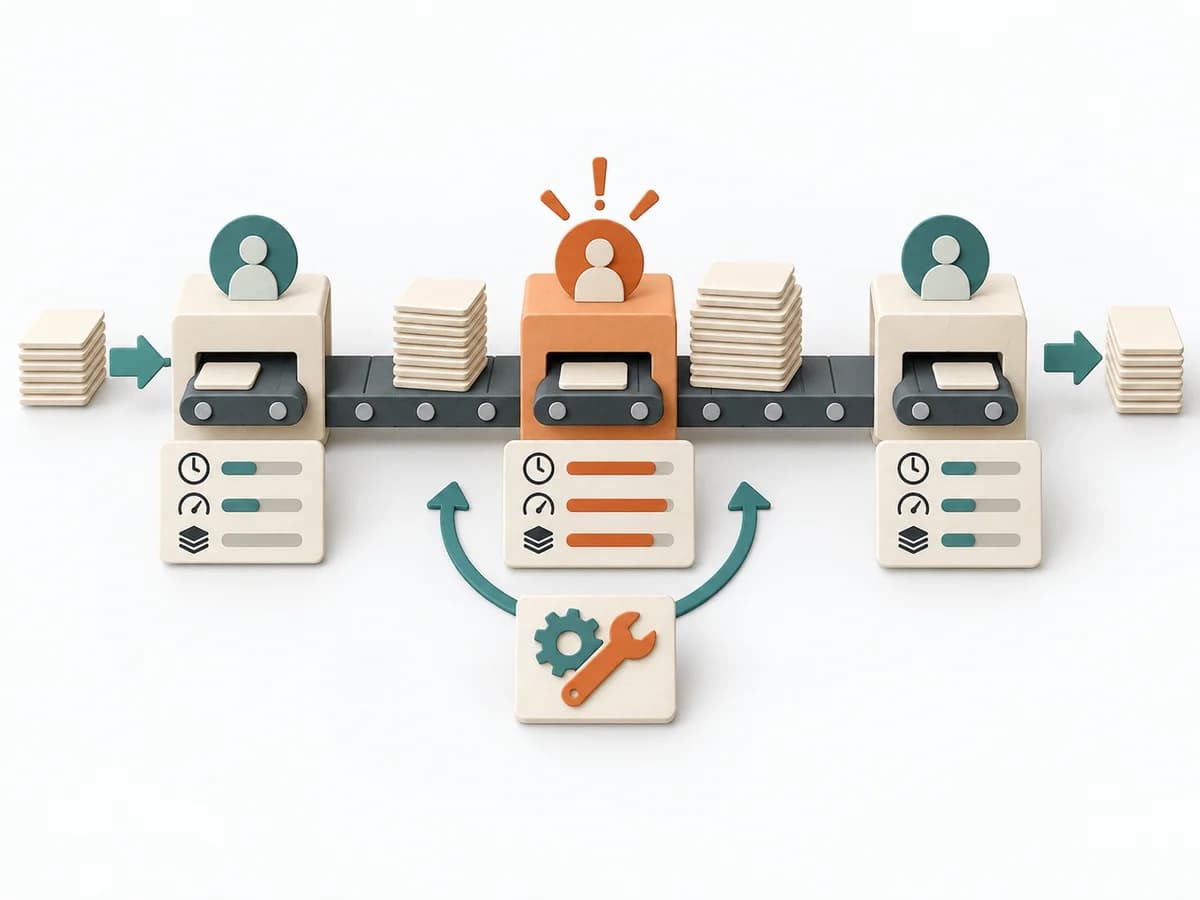 Operations Bottleneck Analysis |  Knowledge Modeling Teach-back |  Decision Making Assumption Surfacing |  Knowledge Modeling Feynman Technique |
|---|---|---|---|---|
Purposedifferent | For a flow that backs up at one point, the method looks for the capacity limit with the greatest leverage. It explains why extra effort elsewhere barely improves throughput. | Teach-back checks whether an explanation actually got through to the other person. The method makes misunderstandings visible early and strengthens shared understanding in advisory and learning situations. | Plans often contain assumptions that were never openly stated and remain dangerous precisely because of that. Assumption Surfacing makes these silent premises visible and prioritizes which of them carry the initiative or could sink it. | The Feynman Technique checks understanding by explaining a topic so that it stays easy for others to understand. It makes knowledge gaps visible before they become costly in everyday work. |
Complexitydifferent | Medium | Low | Low | Low |
Timedifferent | 1-3 h | 5-20 min | 45-90 min | 20-60 min |
Participantsdifferent | 3-8 | 2-8 | 2-8 | 1 |
Formatdifferent | Workshop + async | Workshop + async | Workshop + async | Async |
Outputdifferent | Bottleneck Map, Flow Metrics, Improvement Options, Follow-up Measures | Understanding Check, Clarification Notes, Learning Gaps | Assumption List, Critical Assumptions, Learning Plan | Plain-language Explanation, Knowledge Gaps, Study Notes |
Tagsno overlap | FlowMeasurementConstraints | LearningUnderstandingCommunication | AssumptionsRiskDecisionDiscovery | LearningKnowledgeUnderstanding |