View methods side by side.
Choose up to four methods. Add them using the search and share the comparison by copying its link.
Selected:ATAM (Architecture Tradeoff Analysis Method)Outcome-Driven InnovationRAID LogDesign Thinking
| Criterion |  Architecture ATAM (Architecture Tradeoff Analysis Method) |  Product Discovery Outcome-Driven Innovation | 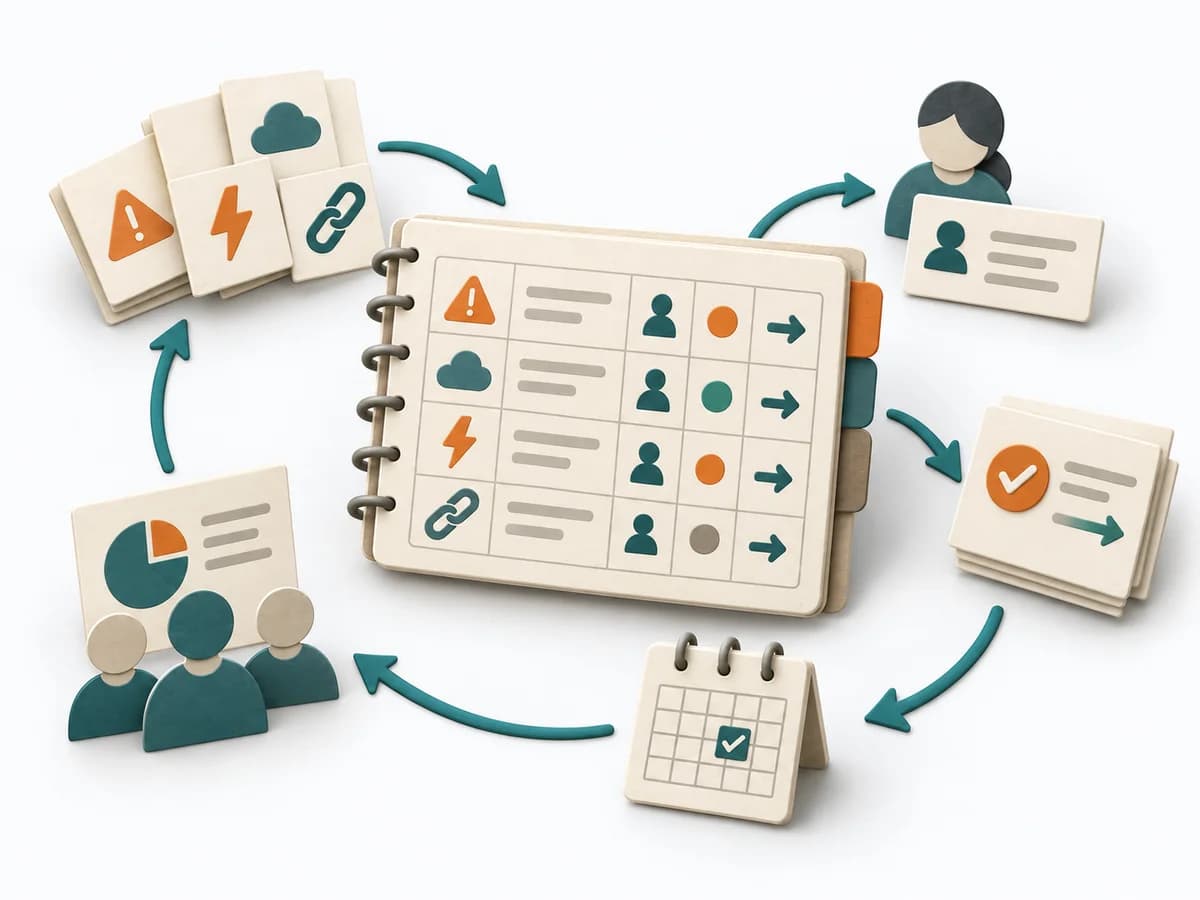 Delivery RAID Log |  Innovation Design Thinking |
|---|---|---|---|---|
Purposedifferent | ATAM helps teams weigh architecture decisions when quality goals compete. The team considers business goals, stakeholder expectations, and technical decisions together. The evaluation shows which risks need further investigation. | Outcome-Driven Innovation clarifies customer problems, solution opportunities, and evidence. It separates jobs, desired outcomes, importance, satisfaction, and opportunity, and captures results as desired outcome statements, an opportunity landscape, and segments by underserved needs. | Helps clarify scope, sequence, and delivery flow in concrete terms. It makes work, boundaries, and order steerable. The result is captured as a RAID Log and a source for status reporting. | For complex user problems with an uncertain cause, the method connects observation, interpretation, and experiment into a learning cycle. It keeps the focus on real needs and avoids premature solution language. This produces robust decisions for product and service. |
Complexitydifferent | High | High | Low | High |
Timedifferent | Several meetings plus preparation and analysis; total effort depends on scope | Mehrere Wochen | 30 min Setup, dann laufend | 1 Tag bis mehrere Wochen |
Participantsdifferent | Evaluation team, architects, and relevant stakeholders | 2-6 researchers plus sample | 1-3 maintaining, briefing for everyone | 4-10 |
Formatdifferent | Workshop + async | Workshop + async | Async | Workshop |
Outputdifferent | Prioritized quality scenarios in a utility tree, Architecture risks with reasoning and assumptions, Sensitivity and trade-off points, Findings report with open investigations | Desired outcome statements, Opportunity landscape, Segmentation by underserved needs, Innovation hypotheses | RAID Log, Status Report Source | Problem Statement, Prototype, Test Learnings |
Tagsno overlap | ArchitectureQualityRiskTradeoffsStakeholders | OutcomesInnovationResearchQuantitative | RiskTrackingStakeholdersGovernance | InnovationPrototypeResearch |