View methods side by side.
Choose up to four methods. Add them using the search and share the comparison by copying its link.
| Criterion |  Product Discovery Assumption Mapping | 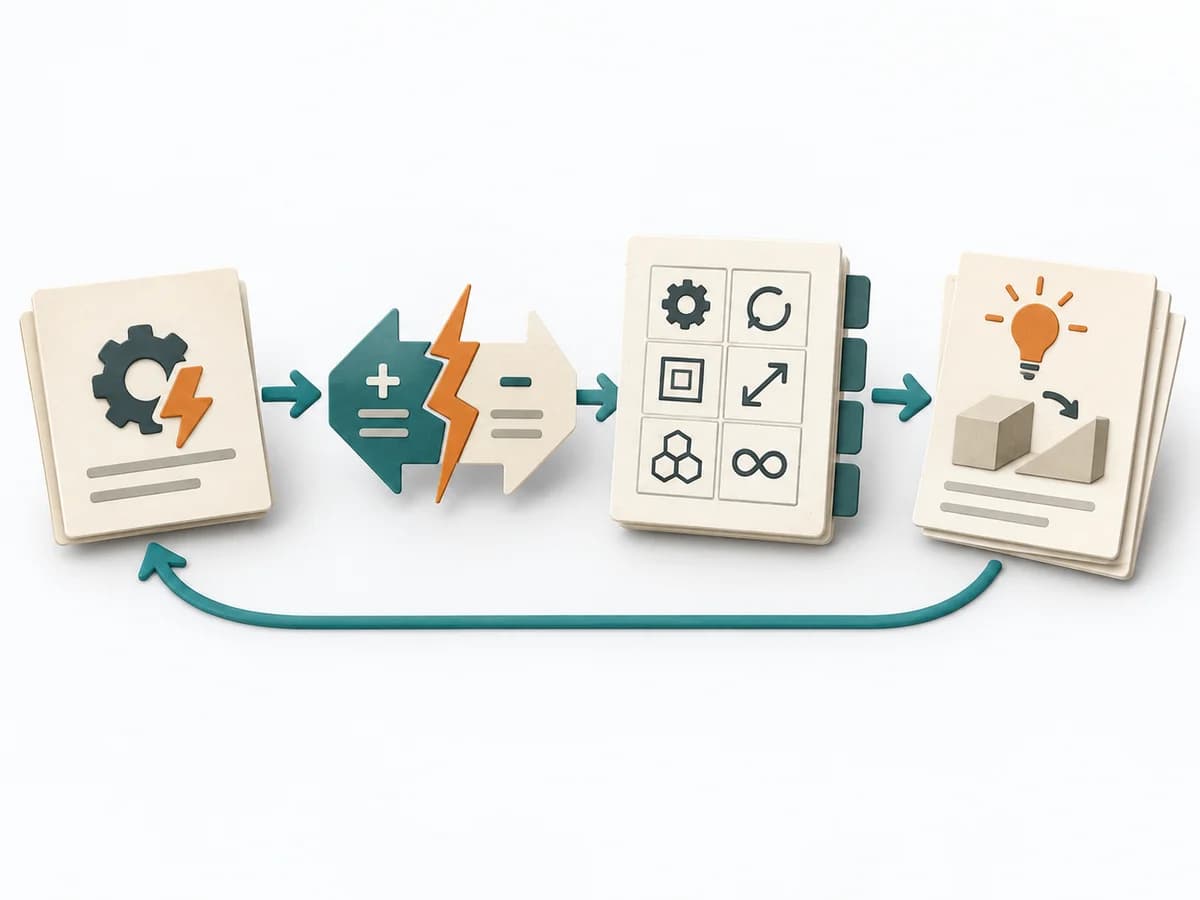 Innovation TRIZ |  Decision Making Assumption Surfacing |  Product Discovery Experiment Canvas |
|---|---|---|---|---|
Purposedifferent | When assumptions still sit unordered in the room, it weighs uncertainty against leverage. It makes visible which hypotheses should be checked first. | For technical contradictions or trade-offs, the method looks for solutions that resolve opposing requirements at the same time. It translates limits into an explicit picture of conflict that becomes workable. This produces not just compromises but more elegant principles. | Plans often contain assumptions that were never openly stated and remain dangerous precisely because of that. Assumption Surfacing makes these silent premises visible and prioritizes which of them carry the initiative or could sink it. | When experiments become unreadable after the fact, it arranges hypothesis, signal, and learning goal on a single canvas. It separates problem, assumption, solution, and evidence. The result is captured as a Completed Experiment Canvas and a Success Metric. |
Complexitydifferent | Medium | High | Low | Low |
Timedifferent | 45-60 min | 1-4 h | 45-90 min | 30-60 min |
Participantsdifferent | 2-8 | 2-8 | 2-8 | 1-5 |
Formatsame | Workshop + async | Workshop + async | Workshop + async | Workshop + async |
Outputdifferent | Assumption map, Test backlog, Risk ranking | Contradiction Statement, Inventive Principles, Solution Concepts | Assumption List, Critical Assumptions, Learning Plan | Completed Experiment Canvas, Success Metric |
Tagsno overlap | AssumptionsRiskExperimentsValidation | InnovationProblem solvingContradictionsCreativity | AssumptionsRiskDecisionDiscovery | ExperimentsValidationDiscoveryHypothesis |