View methods side by side.
Choose up to four methods. Add them using the search and share the comparison by copying its link.
| Criterion |  Decision Making Argument Mapping |  Product Discovery Outcome-Driven Innovation | 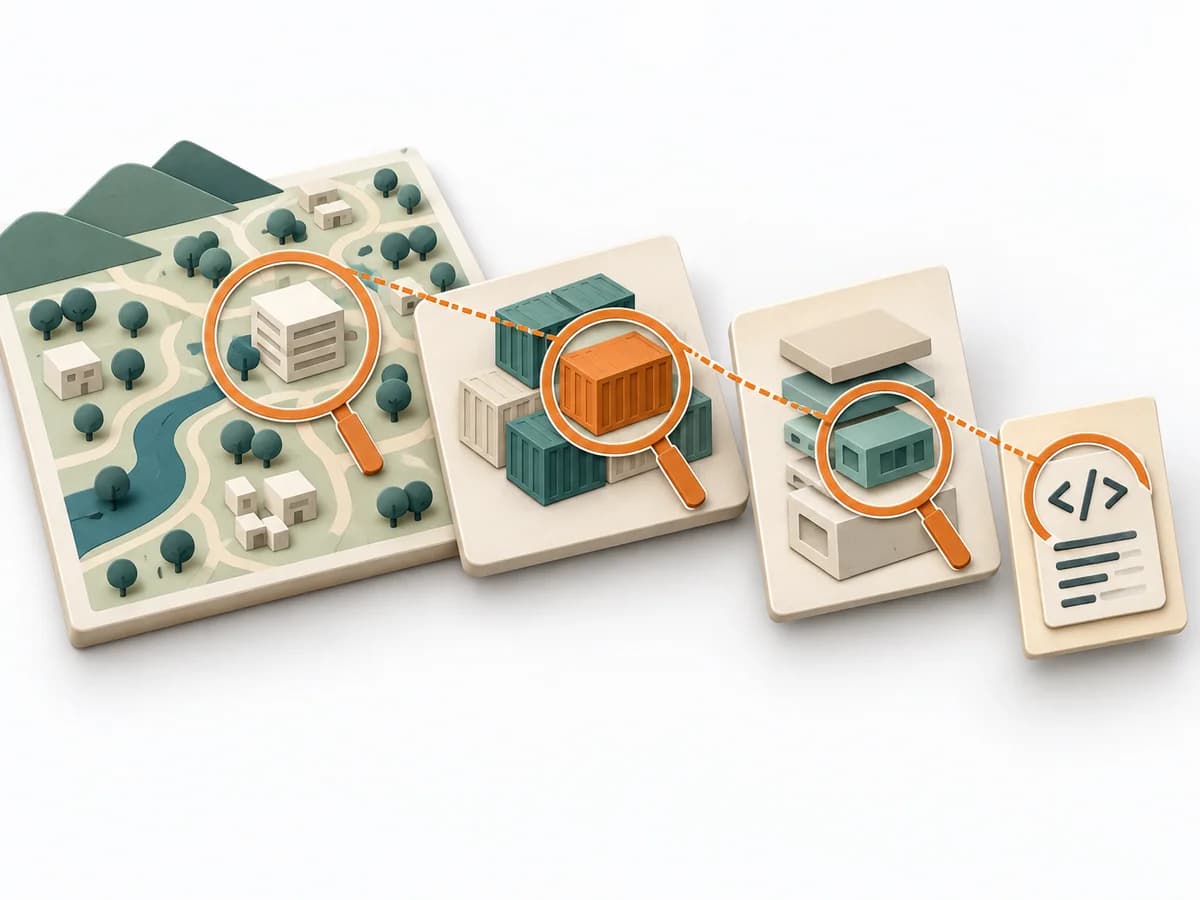 Architecture C4 Model |  Architecture Architecture Decision Record |
|---|---|---|---|---|
Purposedifferent | When statements, evidence, and counterarguments get mixed up, a debate quickly loses its structure. Argument Mapping breaks a thesis down into its reasoning and makes visible what it really rests on. | Outcome-Driven Innovation clarifies customer problems, solution opportunities, and evidence. It separates jobs, desired outcomes, importance, satisfaction, and opportunity, and captures results as desired outcome statements, an opportunity landscape, and segments by underserved needs. | The C4 Model makes a system legible across several resolution levels, from context down to code. It suits situations where different audiences need to understand the same architecture from different altitudes. | An ADR permanently records an architecture decision with context, trade-offs, and consequence. It creates continuity for later changes because the decision path stays traceable. |
Complexitydifferent | Medium | High | Low | Low |
Timedifferent | 1-3 h | Mehrere Wochen | 1-4 h | 15-45 min |
Participantsdifferent | 1-8 | 2-6 researchers plus sample | 1-5 | 1-3 |
Formatdifferent | Workshop + async | Workshop + async | Workshop + async | Async |
Outputdifferent | Argument Map, Evidence Gaps, Decision Rationale | Desired outcome statements, Opportunity landscape, Segmentation by underserved needs, Innovation hypotheses | Context Diagram, Container Diagram, Component Diagram | ADR File, Decision Log, Rationale |
Tagsno overlap | SensemakingDecisionRationale | OutcomesInnovationResearchQuantitative | ArchitectureCommunicationVisualization | ArchitectureRationaleDocumentationGovernance |