View methods side by side.
Choose up to four methods. Add them using the search and share the comparison by copying its link.
| Criterion |  Business Strategy Ansoff Matrix | 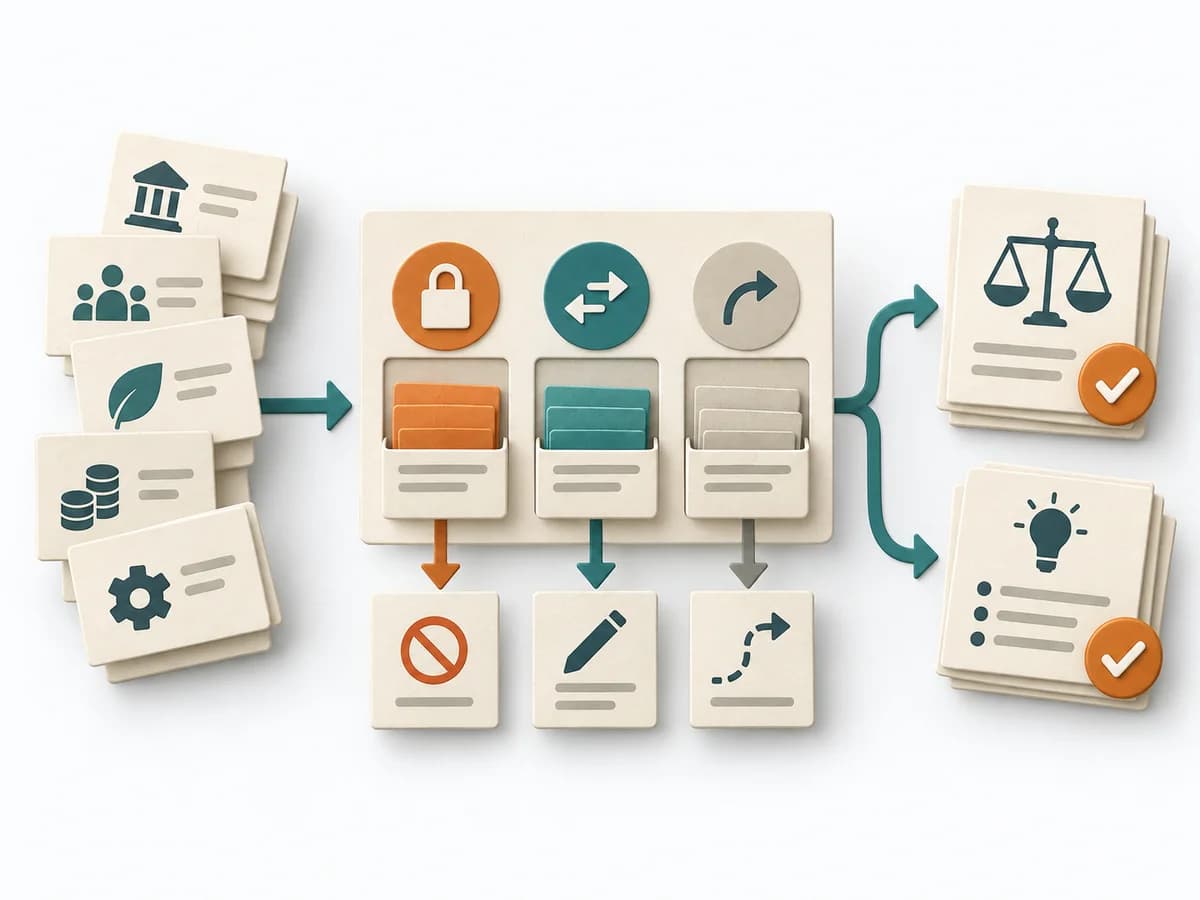 Decision Making Constraint Analysis |  Facilitation Alignment Mapping |  Facilitation Stakeholder Salience Model |
|---|---|---|---|---|
Purposedifferent | The Ansoff Matrix organizes growth options by market and product relation. It helps weigh expansion, diversification, and adaptation cleanly against each other. | When an initiative stalls, the limit often lies not in the idea but in hard or soft boundary conditions. Constraint Analysis separates these limits and shows which of them can actually be shaped. | When several people work toward one goal but hold different mental maps, Alignment Mapping makes the discrepancies visible. It arranges goals, assumptions, and priorities so shared direction becomes verifiable. | When stakeholders appear to matter very differently, the Stakeholder Salience Model rates their actual priority through power, legitimacy, and urgency. It turns individual contributions into a visible selection. The result is captured as a Salience diagram and a class-based strategy. |
Complexitydifferent | Low | Low | Medium | Medium |
Timedifferent | 45-90 min | 30-90 min | 1-2 h | 60-90 min |
Participantsdifferent | 2-8 | 2-8 | 4-12 | 3-6 |
Formatdifferent | Workshop + async | Workshop + async | Workshop | Workshop |
Outputdifferent | Ansoff Matrix, Growth Options, Risk Notes | Constraint List, Hard/Soft Classification, Option Impact Notes, Decision Boundaries | Alignment Map, Open Issues, Decision Questions | Salience Diagram, Strategy per Class |
Tagsno overlap | GrowthStrategyMarketPortfolio | ConstraintsDecisionPlanningOptions | AlignmentStakeholdersStrategyFacilitation | StakeholdersFacilitationAlignmentGovernance |