View methods side by side.
Choose up to four methods. Add them using the search and share the comparison by copying its link.
| Criterion |  UX Research Affinity Diagramming |  Knowledge Modeling IBIS | 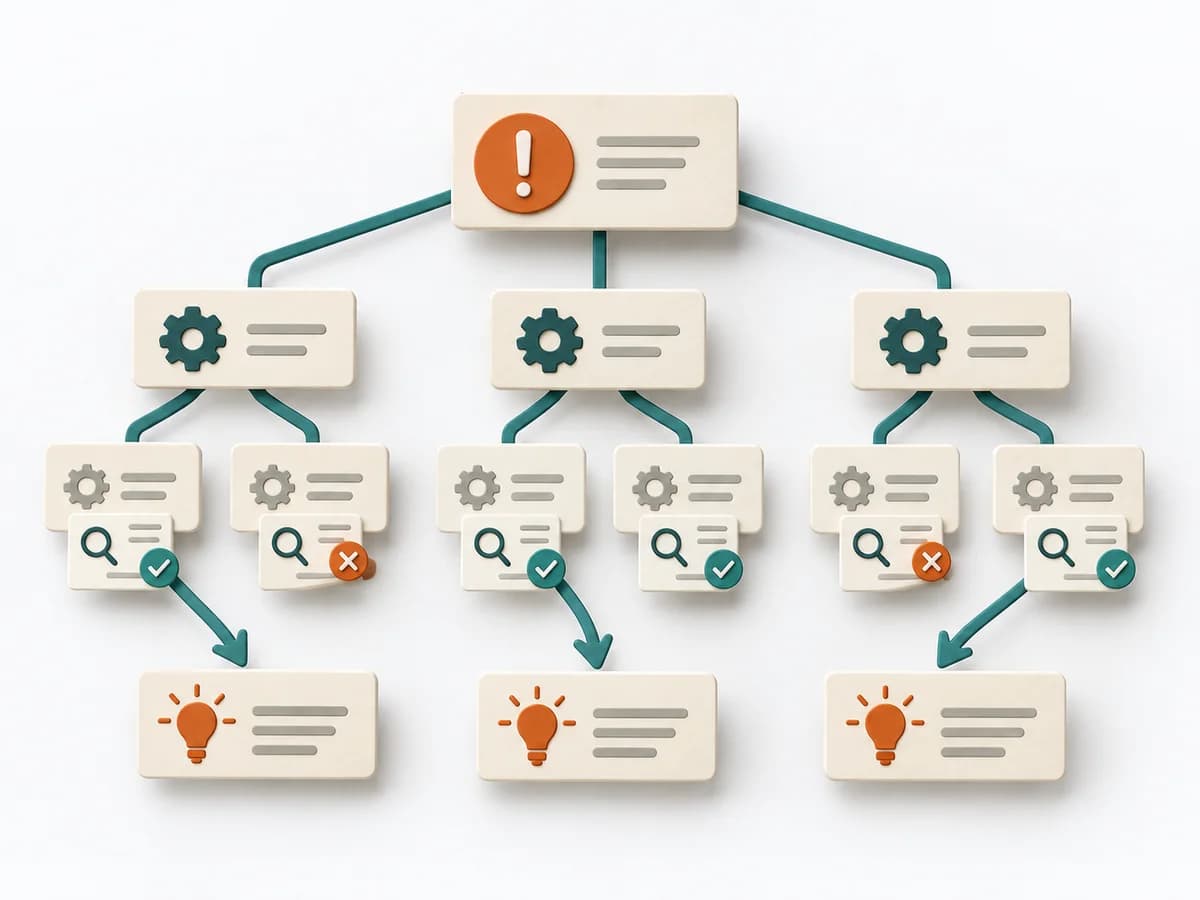 Operations Root Cause Tree Analysis |  Decision Making Argument Mapping |
|---|---|---|---|---|
Purposedifferent | When research notes, feedback, or observations sit unconnected side by side, affinity diagramming sorts the raw material into solid themes. Many individual points turn into patterns that make decisions and opportunities clearer. | IBIS structures thinking about complex questions as a sequence of issues, ideas, and arguments. The method keeps discussions open without forcing them into premature consensus. | For a problem with several suspected causes, the method builds a causal structure instead of a mere list. It makes visible how causes connect and where the strongest points of leverage lie. | When statements, evidence, and counterarguments get mixed up, a debate quickly loses its structure. Argument Mapping breaks a thesis down into its reasoning and makes visible what it really rests on. |
Complexitydifferent | Low | Medium | Medium | Medium |
Timedifferent | 45–90 min | 1-3 h | 1-3 h | 1-3 h |
Participantsdifferent | 3-10 | 2-8 | 2-8 | 1-8 |
Formatdifferent | Workshop | Workshop + async | Workshop | Workshop + async |
Outputdifferent | Theme clusters, Insight statements, Opportunity areas | Issue Map, Positions, Argument Notes | Cause Tree, Evidence Notes, Countermeasures | Argument Map, Evidence Gaps, Decision Rationale |
Tagsno overlap | SynthesisQualitativeRoot cause | RationaleKnowledgeDecision | Root causeTreeIncidentQuality | SensemakingDecisionRationale |