View methods side by side.
Choose up to four methods. Add them using the search and share the comparison by copying its link.
| Criterion |  UX Research Affinity Diagramming |  Systems Thinking Evaporating Cloud | 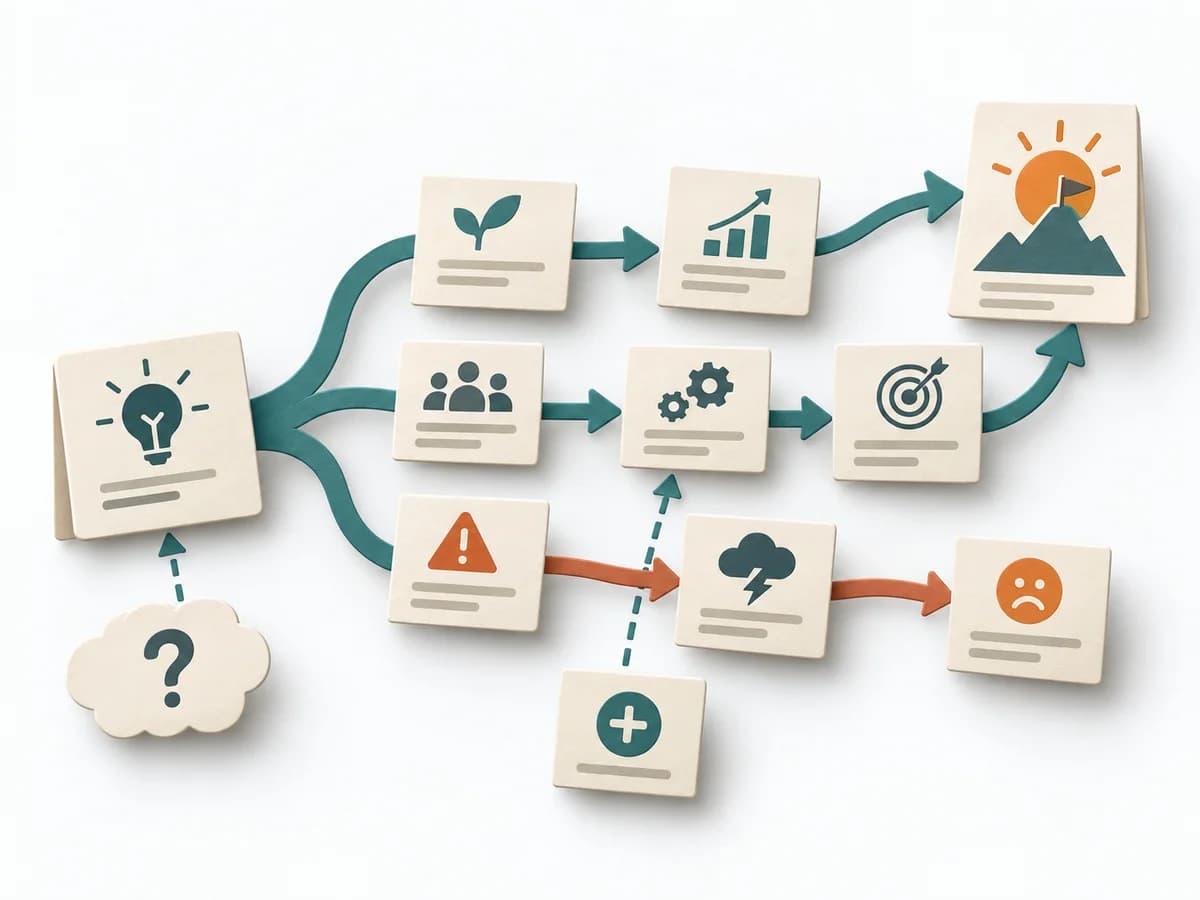 Systems Thinking Future Reality Tree |  Systems Thinking Current Reality Tree |
|---|---|---|---|---|
Purposedifferent | When research notes, feedback, or observations sit unconnected side by side, affinity diagramming sorts the raw material into solid themes. Many individual points turn into patterns that make decisions and opportunities clearer. | The method makes visible why two seemingly incompatible demands arise and which assumption must be tested to resolve the conflict. | A Future Reality Tree shows how desired actions are meant to lead to a better system state. The method checks whether a path of change holds together logically before time flows into implementation. | A Current Reality Tree condenses many symptoms into a few causal chains. The method makes visible which core problems drive several negative effects at once. |
Complexitydifferent | Low | Medium | High | High |
Timedifferent | 45–90 min | 60-120 min | 2-4 h | 2-6 h |
Participantsdifferent | 3-10 | 2-8 | 3-8 | 3-8 |
Formatsame | Workshop | Workshop | Workshop | Workshop |
Outputdifferent | Theme clusters, Insight statements, Opportunity areas | Conflict Cloud, Assumption List, Breakthrough Ideas, Next Experiments | Future Reality Tree, Negative Branches, Assumption List, Improved Injections | Current Reality Tree, Core Problems, Intervention Ideas |
Tagsno overlap | SynthesisQualitativeRoot cause | Theory of ConstraintsAssumptionsSystems thinking | Theory of ConstraintsSystems thinkingChange | Systems thinkingRoot causeConstraintsCausality |