View methods side by side.
Choose up to four methods. Add them using the search and share the comparison by copying its link.
| Criterion |  UX Research Affinity Diagramming | 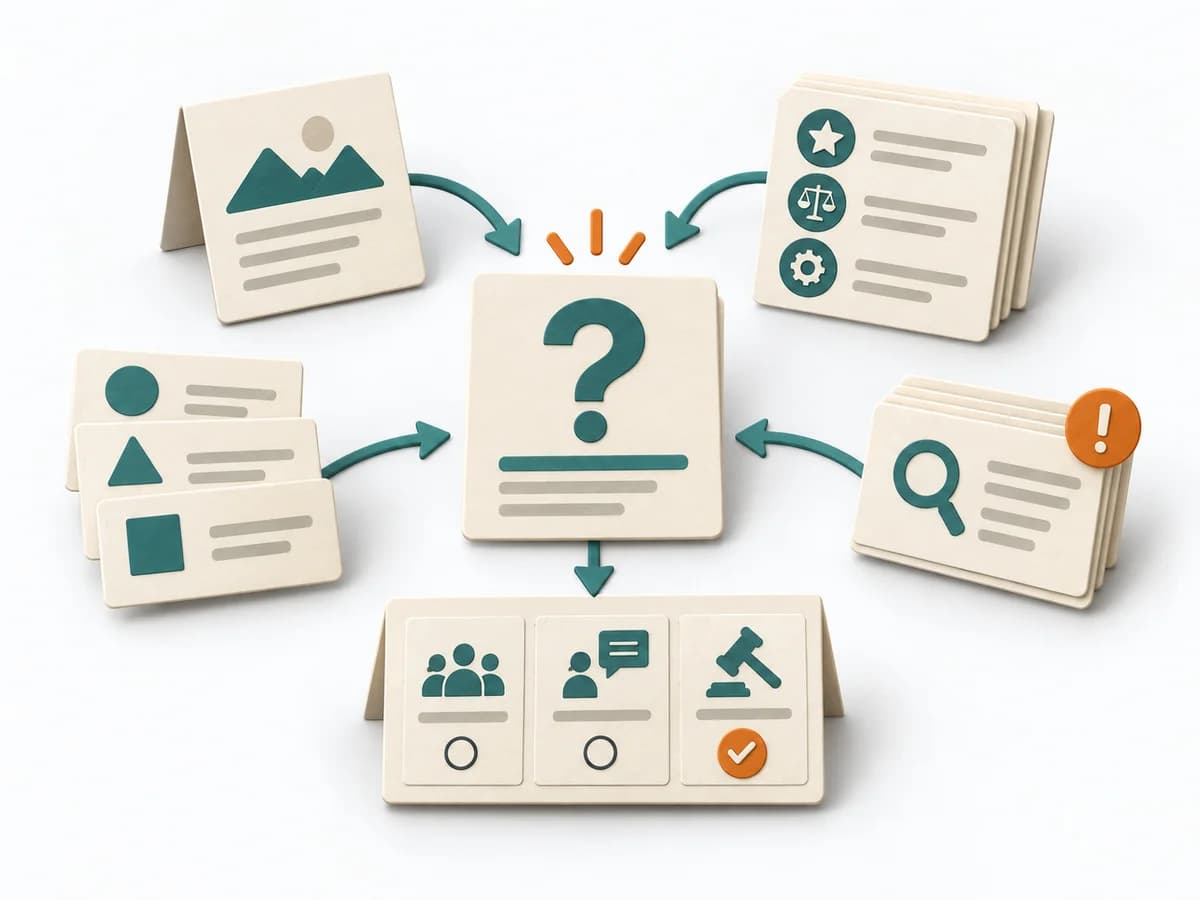 Decision Making Decision Framing Workshop |  Operations Change Analysis |  UX Research Empathy Mapping |
|---|---|---|---|---|
Purposedifferent | When research notes, feedback, or observations sit unconnected side by side, affinity diagramming sorts the raw material into solid themes. Many individual points turn into patterns that make decisions and opportunities clearer. | When a decision is poorly framed, even good answers deliver little value. A Decision Framing Workshop sharpens the problem, goal, and boundaries before the actual weighing begins. | For a deviation after a change, the method isolates the influence of the altered condition. It narrows down which differences are relevant and which are just accompanying noise. | When a lot is assumed about a target group but little is seen jointly, empathy mapping makes knowledge and gaps directly comparable. The picture also shows which assumptions hold up and where evidence is missing. |
Complexitydifferent | Low | Medium | Medium | Low |
Timedifferent | 45–90 min | 60-120 min | 45-120 min | 30–60 min |
Participantsdifferent | 3-10 | 4-10 | 2-6 | 4-8 |
Formatdifferent | Workshop | Workshop | Workshop + async | Workshop |
Outputdifferent | Theme clusters, Insight statements, Opportunity areas | Decision Frame, Decision Question, Criteria List, Evidence Plan | Change Matrix, Cause Hypotheses, Validation Questions, Action List | Empathy Map, Assumptions List, Research Gaps |
Tagsno overlap | SynthesisQualitativeRoot cause | Decision framingAlignmentCriteriaOptions | ChangeRoot causeTroubleshootingComparison | SynthesisQualitativeWorkshop |