View methods side by side.
Choose up to four methods. Add them using the search and share the comparison by copying its link.
| Criterion |  UX Research Affinity Diagramming |  Architecture Architecture Decision Record | 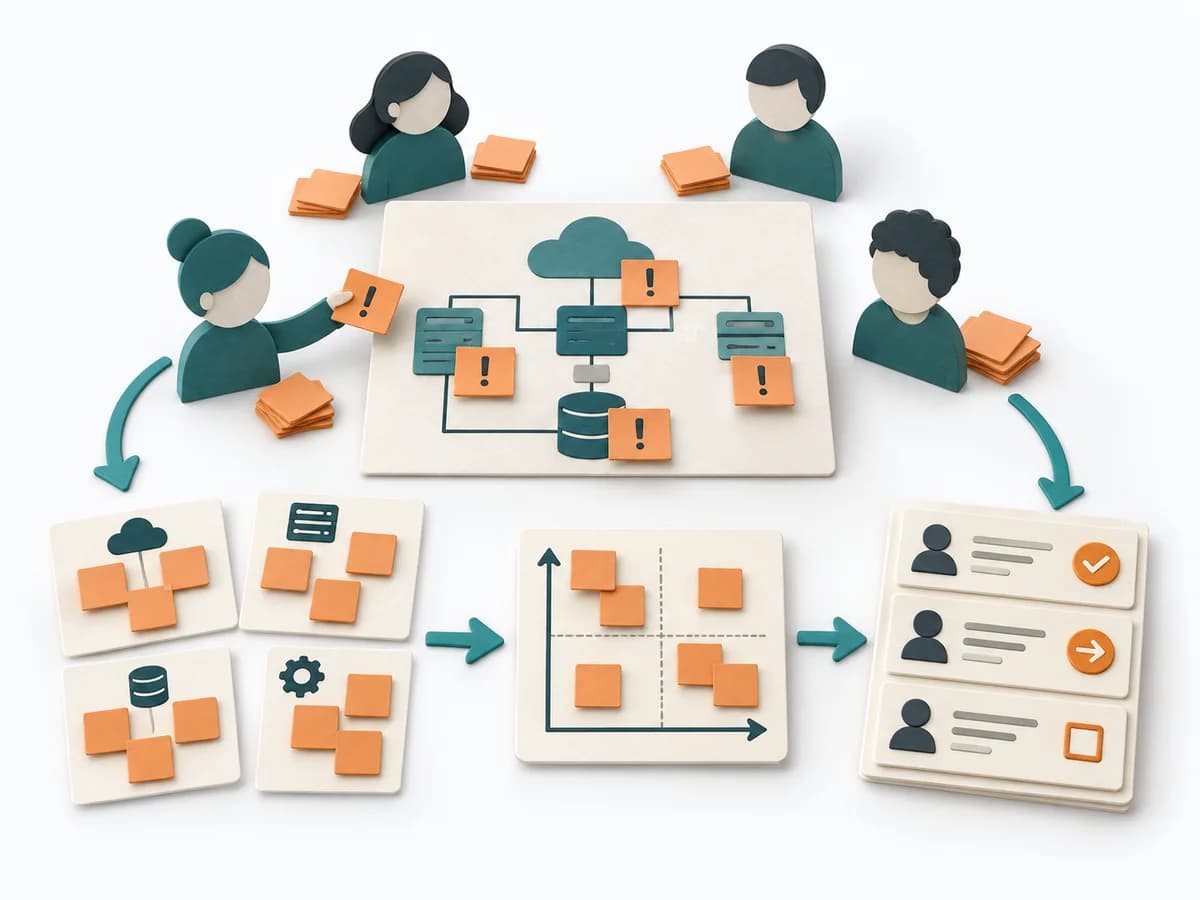 Architecture Risk Storming |  Product Discovery Assumption Mapping |
|---|---|---|---|---|
Purposedifferent | When research notes, feedback, or observations sit unconnected side by side, affinity diagramming sorts the raw material into solid themes. Many individual points turn into patterns that make decisions and opportunities clearer. | An ADR permanently records an architecture decision with context, trade-offs, and consequence. It creates continuity for later changes because the decision path stays traceable. | Helps clarify architecture context, options, and consequences in concrete terms. It organizes technical context, alternatives, and consequences. The result is captured as an Annotated Diagram, a Prioritized Risk List, and an Action Backlog. | When assumptions still sit unordered in the room, it weighs uncertainty against leverage. It makes visible which hypotheses should be checked first. |
Complexitydifferent | Low | Low | Low | Medium |
Timedifferent | 45–90 min | 15-45 min | 60-90 min | 45-60 min |
Participantsdifferent | 3-10 | 1-3 | 4-12 | 2-8 |
Formatdifferent | Workshop | Async | Workshop | Workshop + async |
Outputdifferent | Theme clusters, Insight statements, Opportunity areas | ADR File, Decision Log, Rationale | Annotated Diagram, Prioritized Risk List, Action Backlog | Assumption map, Test backlog, Risk ranking |
Tagsno overlap | SynthesisQualitativeRoot cause | ArchitectureRationaleDocumentationGovernance | RiskArchitectureWorkshopValidation | AssumptionsRiskExperimentsValidation |