View methods side by side.
Choose up to four methods. Add them using the search and share the comparison by copying its link.
| Criterion | 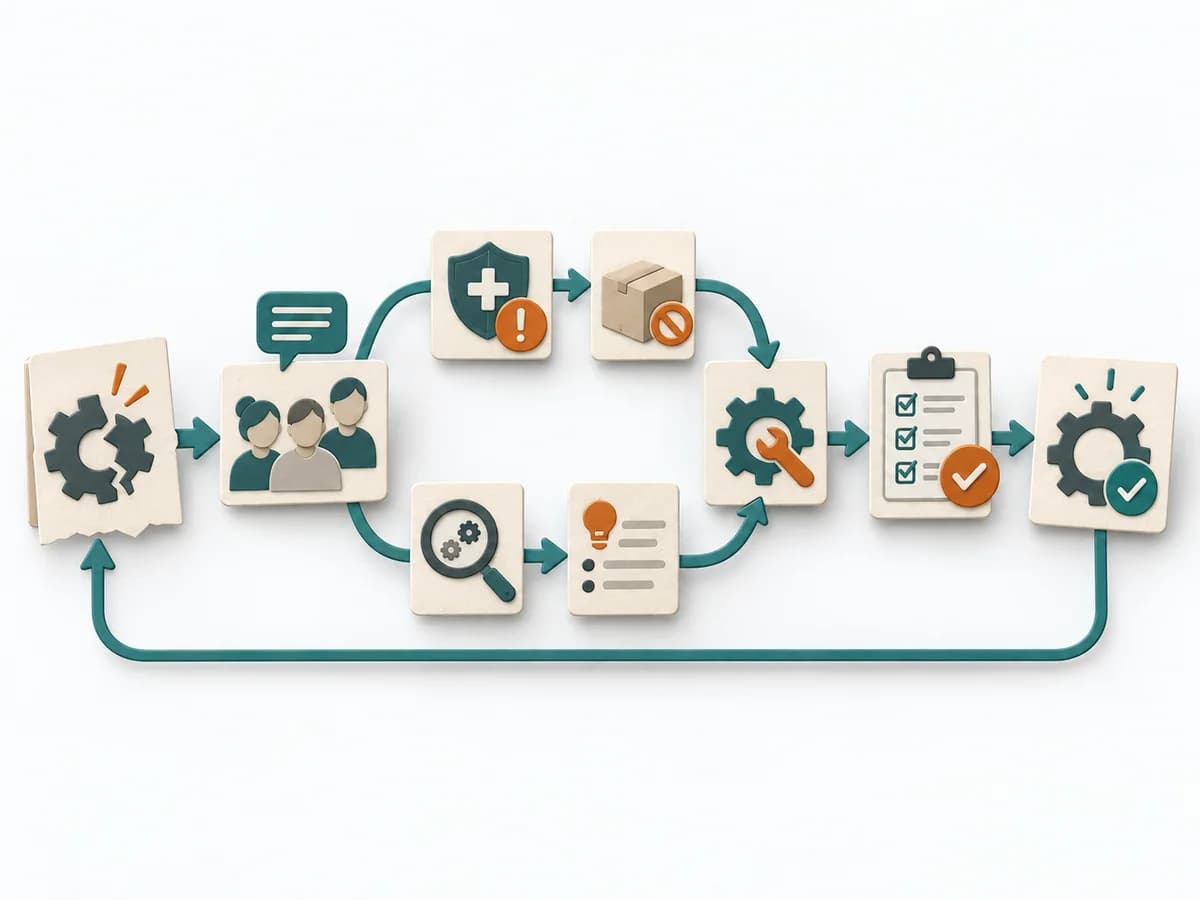 Operations 8D Problem Solving |  Decision Making Decision Rights Mapping |  Operations Kepner-Tregoe |  Operations Failure Mode and Effects Analysis |
|---|---|---|---|---|
Purposedifferent | For an acute quality or delivery problem, the method structures immediate protection and root cause work together. It keeps the situation stable while the actual cause is investigated cleanly. | In organizations with many stakeholders, it often blurs who actually decides and who is merely consulted. It separates options, evaluation criteria, and open risks. The result is captured as a Decision Rights matrix and an agreement. | For a disturbance that's hard to pin down, the method cleanly separates problem, cause, and decision. It reduces mixing when symptoms allow several interpretations. | For a process, product, or service with noticeable failure risks, the method assesses possible failure modes in advance. It directs attention to combinations of occurrence, effect, and detectability. |
Complexitydifferent | High | Medium | High | High |
Timedifferent | 1-6 Wochen | 90-180 min | 2-8 h | 2-6 h |
Participantsdifferent | 4-10 | 4-12 | 2-8 | 3-10 |
Formatdifferent | Workshop + async | Workshop | Workshop + async | Workshop |
Outputdifferent | 8D Report, Containment Plan, Root Cause Evidence, Corrective Action Plan | Decision Rights Matrix, Agreement | Problem Analysis, Decision Analysis, Risk Plan | FMEA Table, Risk Priority, Mitigation Actions |
Tagsno overlap | QualityProblem solvingRoot cause | DecisionGovernanceAlignmentResponsibility | Problem solvingRoot causeDecisionOperations | RiskQualityOperationsRoot cause |