Complete firstClear boundary
Set incident, period, and system boundary; preserve volatile sources and normalise time zones.
Without a boundary, cases, periods, or variables become mixed.
A practical method guide: clarify prerequisites and materials, understand the complete process, and look up outputs, pitfalls, and stop criteria.
What needs to be finished first
Set incident, period, and system boundary; preserve volatile sources and normalise time zones.
Logs, alerts, deployments, tickets, chat timestamps, timeline, and evidence register
What needs to be ready before start
Logs, alerts, deployments, tickets, chat timestamps, timeline, and evidence register
Incident lead · direct participants · scribe · system experts · action owners
Set incident, period, and system boundary; preserve volatile sources and normalise time zones.
2–8 hours for evidence preservation plus 60–120 minutes joint analysis.
Prepare a workspace with Preserve · Sequence · Context · Gaps · Learn; separate example from live data.
The one question this method answers
Which evidenced event sequence explains detection, response, and impact without projecting later knowledge into earlier decisions?
Phases with goal, actions, output and pitfall
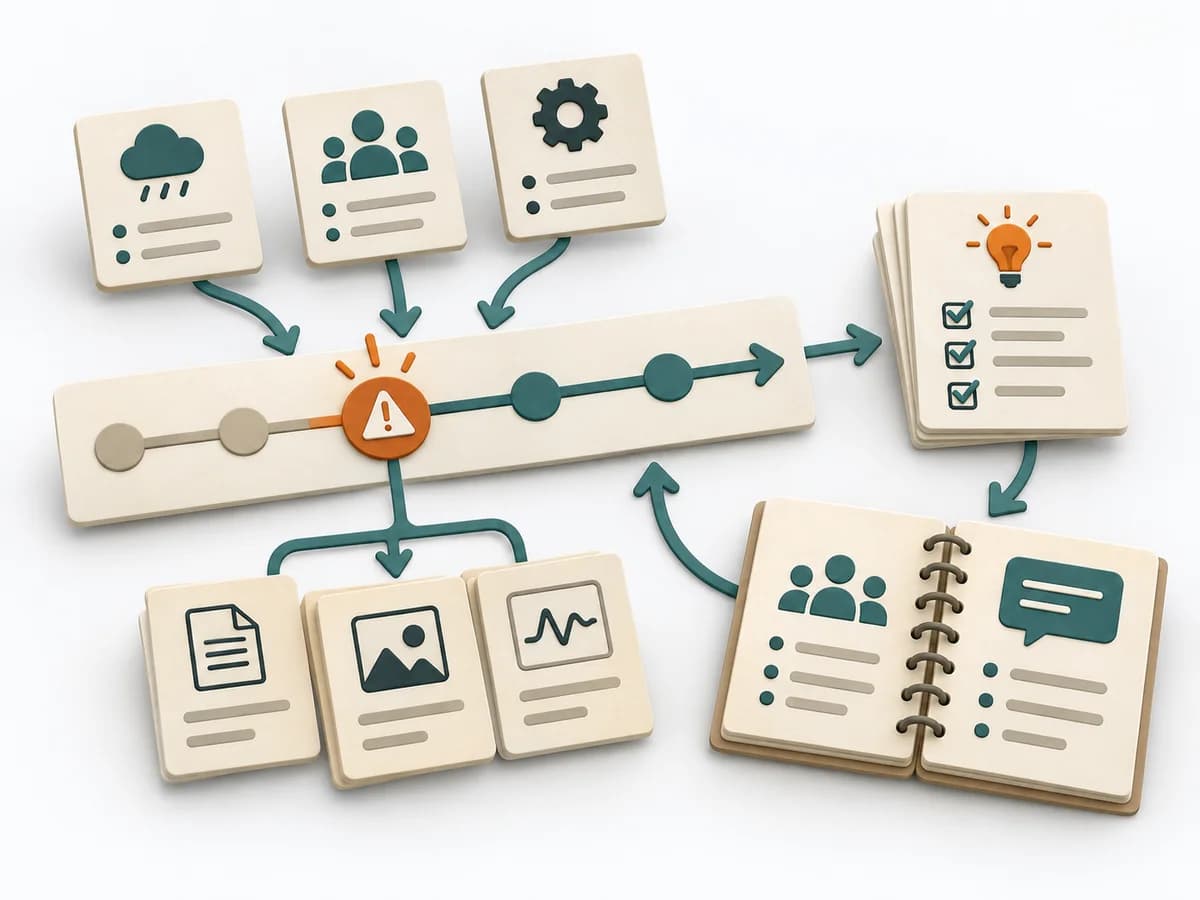
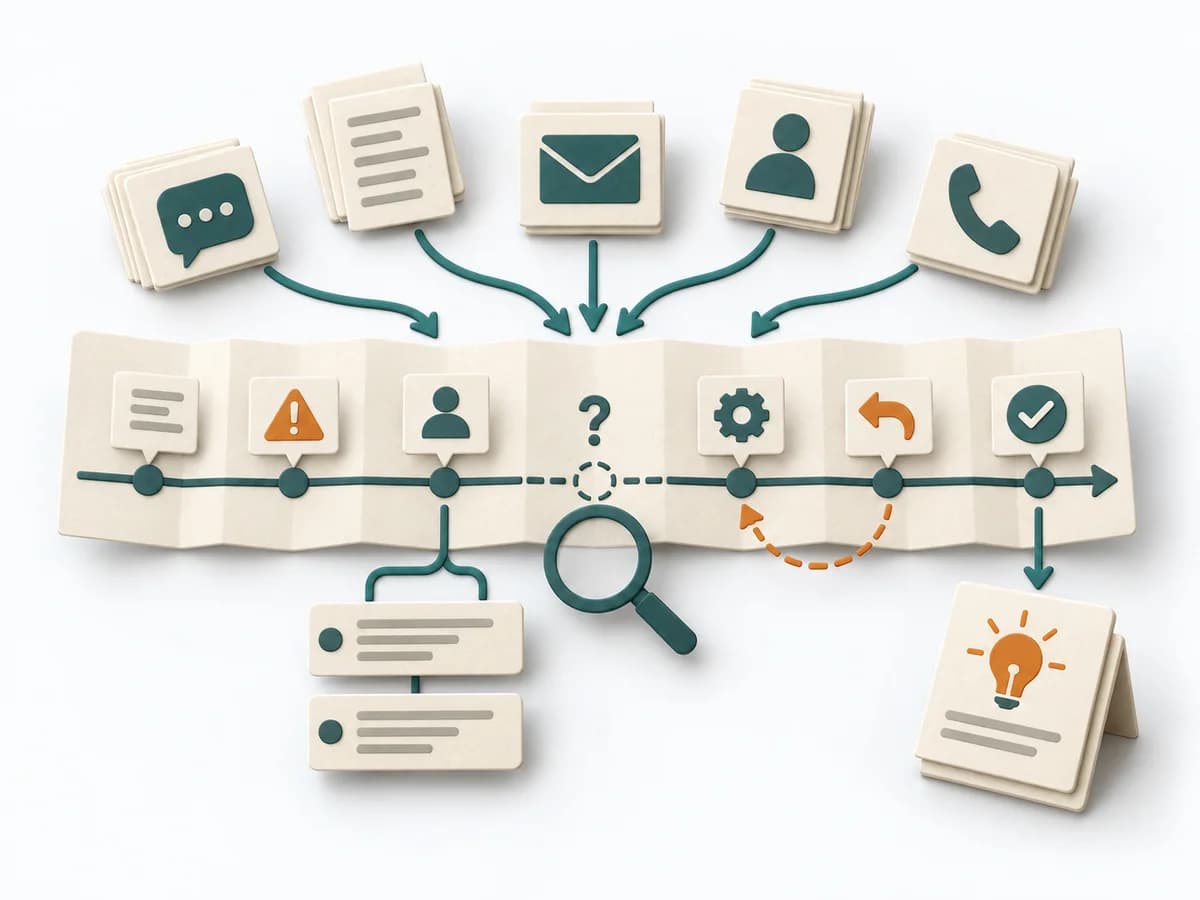
Ereignisse werden aus verschiedenen Quellen zusammengeführt und chronologisch verdichtet. Dadurch werden Lücken, Parallelitäten und spätere Korrekturen erkennbar. Die Zeitlinie schafft eine belastbare Basis für die Bewertung von Reaktionsgeschwindigkeit und Entscheidungsqualität.
Fictional example
Fictional values show the actual method fields.
| Event | Time | Source | Observation | Information state | Decision | Certainty |
|---|---|---|---|---|---|---|
| Pool riseAdd evidence and rationale. | 09:12 UTC | APM export | Pool at 95%; checkout timeouts begin | Dashboard shows checkout connections only | No decision yet | Confirmed |
| RestartAdd evidence and rationale. | 09:18 UTC | Incident log and chat | API is restarted | Batch load is invisible on dashboard | Restart per runbook | Confirmed |
| Batch pauseAdd evidence and rationale. | 09:31 UTC | Scheduler log | Batch is paused | Batch occupancy identified | Stop batch | Confirmed |
All values are fictional.
Preserve
Goal
Source package: Preserve logs, alerts, deployments, tickets, and communication unchanged; align clocks and time zones.
Inputs for this step
Actions
Output
Source package
Preserve logs, alerts, deployments, tickets, and communication unchanged; align clocks and time zones.
Quality check
Are original source, time basis, and retention state known?
Pitfall
Screenshots without provenance replace raw data. Preserve export and original reference; record normalisation.
Timing: 30–90 minutes
Sequence
Goal
Evidence timeline: Order observable events by time, source, and actor; mark uncertainty as a range.
Inputs for this step
Actions
Output
Evidence timeline
Order observable events by time, source, and actor; mark uncertainty as a range.
Quality check
Does each row cite a source and separate observation from interpretation?
Pitfall
Remembered order receives invented minute values. Mark uncertain time as interval and retain conflicts.
Timing: 45–90 minutes
Context
Goal
Decision context: Attach persistent conditions, information then available, and decision rationale.
Inputs for this step
Actions
Output
Decision context
Attach persistent conditions, information then available, and decision rationale.
Quality check
Is each decision assessed using knowledge available at the time?
Pitfall
Hindsight makes the prior action look irrational. Add information and options available at decision time.
Timing: 30–60 minutes
Gaps
Goal
Resolved gaps: Investigate conflicts, missing periods, and open causal questions.
Inputs for this step
Actions
Output
Resolved gaps
Investigate conflicts, missing periods, and open causal questions.
Quality check
Are additions labelled as new evidence rather than narrative?
Pitfall
Team smooths gaps into a neat story. Name gap, assign search, and record residual uncertainty.
Timing: 20–45 minutes
Learn
Goal
Learning plan: Derive detection, response, and system patterns; tie actions to evidence and effect signals.
Inputs for this step
Actions
Output
Learning plan
Derive detection, response, and system patterns; tie actions to evidence and effect signals.
Quality check
Does each action cite a finding and testable effect?
Pitfall
Timeline remains chronology without learning. Link each action to node, owner, signal, and review.
Timing: 30–45 minutes
What comes out at the end
Sketch: what the artifact looks like
Source-bound incident timeline with events, conditions, decisions, information state, gaps, and learning points.
Record date, owner, source state, and review date; preserve prior versions.
Chronological template for incident reconstruction with sources and uncertainty.
Incident: ... Period: ... Sources: logs, alerts, chat, tickets
| Time | Event | Source | Confidence | Note |
|---|---|---|---|---|
| HH:MM | high/medium/low |
Set subject, evidence, roles, flow, and review.
To be confirmed
To be confirmed
Whole initiative Time: 2–8 hours for evidence preservation plus 60–120 minutes joint analysis.
Complete this worksheet on paper or in your own document during the work.
| Event | Time | Source | Observation | Information state | Decision | Certainty |
|---|---|---|---|---|---|---|
| Pool rise | ||||||
| Restart | ||||||
| Batch pause |
The blank worksheet contains prompts only.
Reference · original teaching example
Expected artifact: Source package
Preserve logs, alerts, deployments, tickets, and communication unchanged; align clocks and time zones.
Entry:
...
Expected artifact: Evidence timeline
Order observable events by time, source, and actor; mark uncertainty as a range.
Entry:
...
Expected artifact: Decision context
Attach persistent conditions, information then available, and decision rationale.
Entry:
...
Expected artifact: Resolved gaps
Investigate conflicts, missing periods, and open causal questions.
Entry:
...
Expected artifact: Learning plan
Derive detection, response, and system patterns; tie actions to evidence and effect signals.
Entry:
...
...
Method guide: https://methodatlas.meierhoff-systems.de/en/methods/incident-timeline-analysis/run-sheet
Concrete filled scenario, fictional example
Fictional example for orientation. Counts and timings describe this case and are not universal requirements.
Concrete filled scenario, fictional example
| Event | Time | Source | Observation | Information state | Decision | Certainty |
|---|---|---|---|---|---|---|
| Pool rise | 09:12 UTC | APM export | Pool at 95%; checkout timeouts begin | Dashboard shows checkout connections only | No decision yet | Confirmed |
| Restart | 09:18 UTC | Incident log and chat | API is restarted | Batch load is invisible on dashboard | Restart per runbook | Confirmed |
| Batch pause | 09:31 UTC | Scheduler log | Batch is paused | Batch occupancy identified | Stop batch | Confirmed |
Recognize symptoms and steer against them
Quick overview, the full text is in the matching phase in the flow
Screenshots without provenance replace raw data.
Preserve export and original reference; record normalisation.
Remembered order receives invented minute values.
Mark uncertain time as interval and retain conflicts.
Hindsight makes the prior action look irrational.
Add information and options available at decision time.
Team smooths gaps into a neat story.
Name gap, assign search, and record residual uncertainty.
Timeline remains chronology without learning.
Link each action to node, owner, signal, and review.
When to pause, resolve prerequisites, or choose another approach
Go to the profile for purpose, similar methods, and sources or continue to the next method in the catalog.