View methods side by side.
Choose up to four methods. Add them using the search and share the comparison by copying its link.
| Criterion |  UX Research Surveys |  Decision Making DACI | 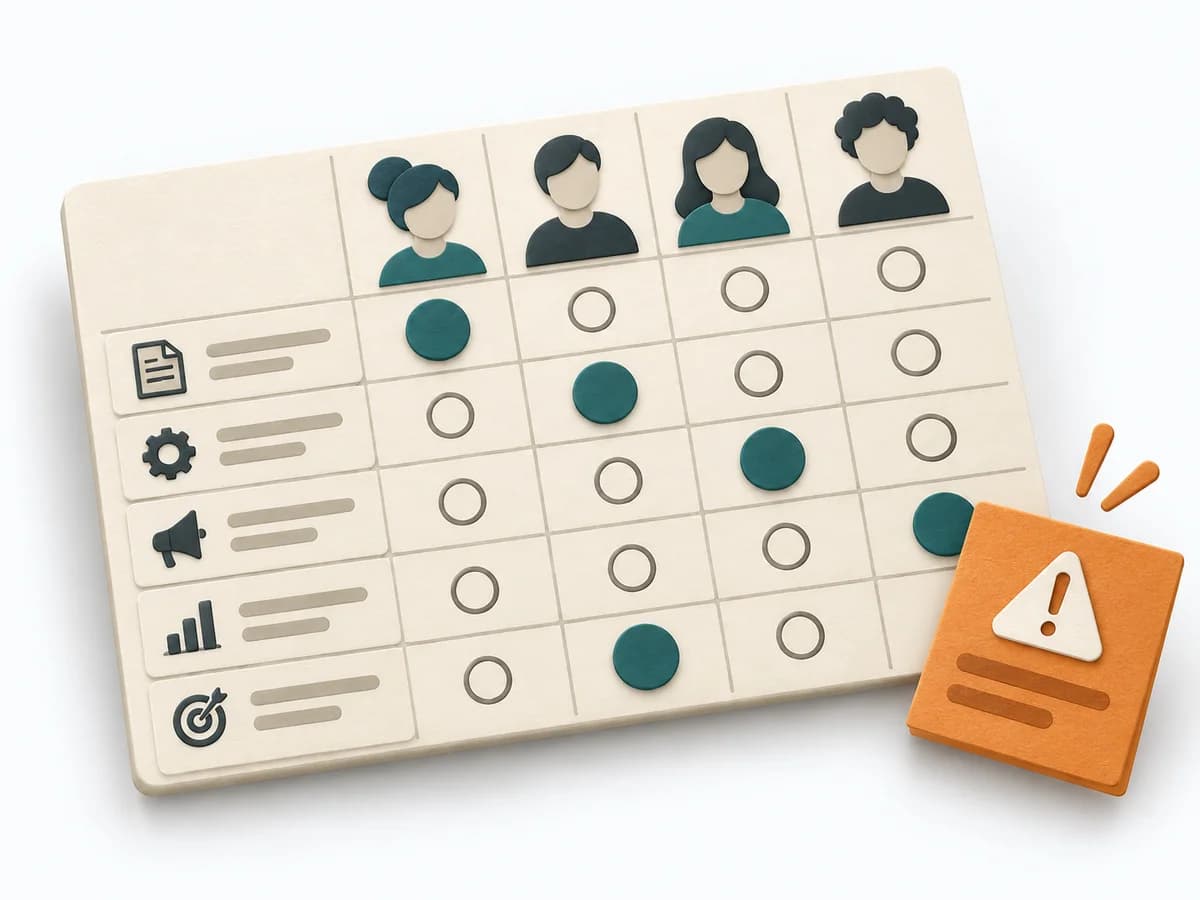 Operations RACI Matrix |  Product Discovery Outcome-Driven Innovation |
|---|---|---|---|---|
Purposedifferent | When a topic needs to be validated broadly and many people can answer the same question, surveys gather structured feedback in a scalable form. Answers become comparable and segmentable instead of remaining merely anecdotal. | In cross-functional decisions, responsibilities quickly blur between approval, influence, and execution. DACI arranges these roles so decision pressure, contribution, and information stay cleanly separated. | With unclear responsibilities across several roles or areas, the method creates unambiguous accountability logic. It reduces friction because decision, execution, contribution, and information become separately visible. | Outcome-Driven Innovation clarifies customer problems, solution opportunities, and evidence. It separates jobs, desired outcomes, importance, satisfaction, and opportunity, and captures results as desired outcome statements, an opportunity landscape, and segments by underserved needs. |
Complexitydifferent | Medium | Low | Low | High |
Timedifferent | 3-14 Tage | 30-60 min | 45-90 min | Mehrere Wochen |
Participantsdifferent | 50+ | 2-10 | 2-8 | 2-6 researchers plus sample |
Formatdifferent | Async | Workshop + async | Workshop + async | Workshop + async |
Outputdifferent | Survey Results, Charts, Segment Insights | DACI Matrix, Decision Owner, Decision Log | RACI Matrix, Responsibility Map, Decision Notes | Desired outcome statements, Opportunity landscape, Segmentation by underserved needs, Innovation hypotheses |
Tagsno overlap | QuantitativeResearchValidation | DecisionRolesGovernanceAlignment | RolesResponsibilityGovernanceOperations | OutcomesInnovationResearchQuantitative |