View methods side by side.
Choose up to four methods. Add them using the search and share the comparison by copying its link.
| Criterion |  Facilitation Six Thinking Hats | 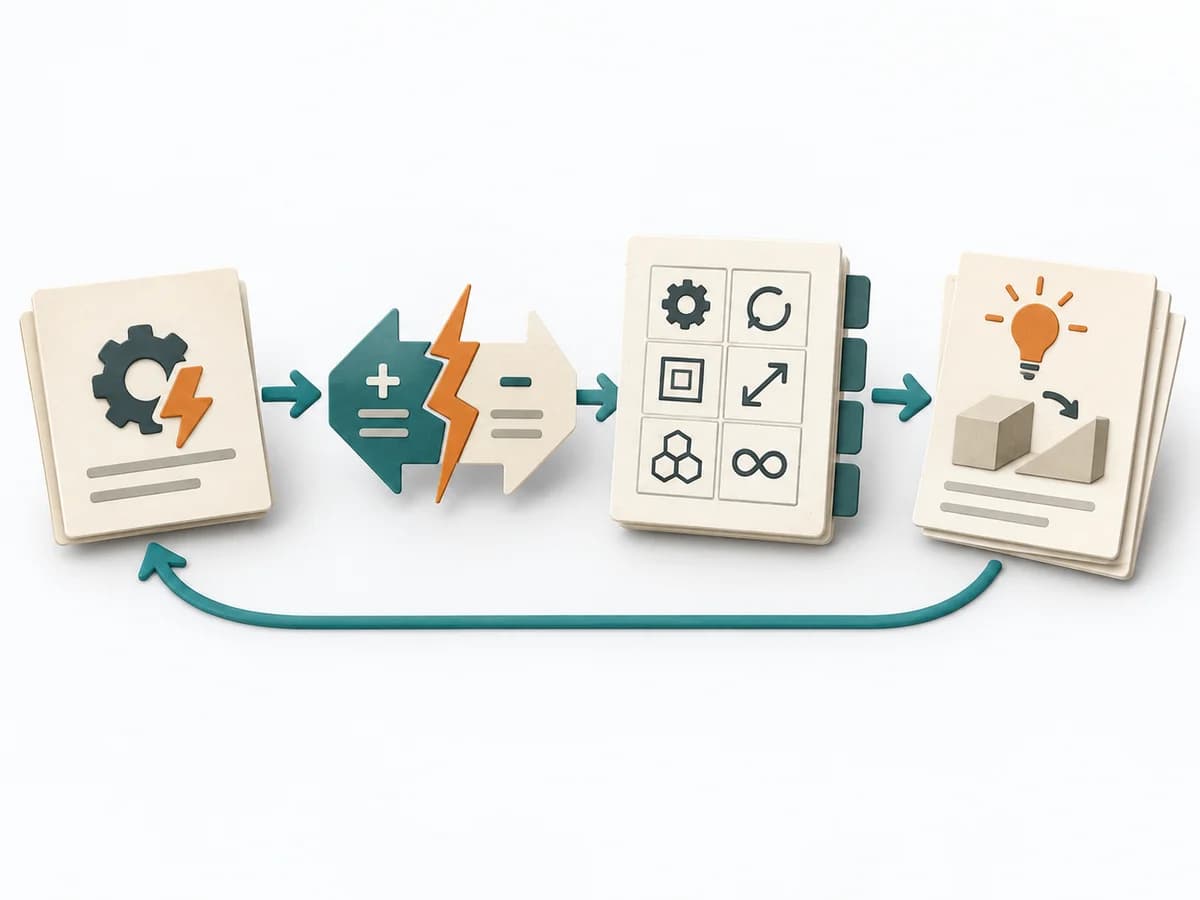 Innovation TRIZ |  Decision Making Constraint Analysis |  Operations Kepner-Tregoe |
|---|---|---|---|---|
Purposedifferent | When a topic gets stuck too quickly in the same thinking mode, Six Thinking Hats deliberately separates the perspectives. This means facts, risks, creativity, and emotional signals get worked through one after another instead of mixed together. | For technical contradictions or trade-offs, the method looks for solutions that resolve opposing requirements at the same time. It translates limits into an explicit picture of conflict that becomes workable. This produces not just compromises but more elegant principles. | When an initiative stalls, the limit often lies not in the idea but in hard or soft boundary conditions. Constraint Analysis separates these limits and shows which of them can actually be shaped. | For a disturbance that's hard to pin down, the method cleanly separates problem, cause, and decision. It reduces mixing when symptoms allow several interpretations. |
Complexitydifferent | Medium | High | Low | High |
Timedifferent | 45-90 min | 1-4 h | 30-90 min | 2-8 h |
Participantsdifferent | 4-12 | 2-8 | 2-8 | 2-8 |
Formatdifferent | Workshop | Workshop + async | Workshop + async | Workshop + async |
Outputdifferent | Perspective Notes, Decision Inputs, Action Items | Contradiction Statement, Inventive Principles, Solution Concepts | Constraint List, Hard/Soft Classification, Option Impact Notes, Decision Boundaries | Problem Analysis, Decision Analysis, Risk Plan |
Tagsno overlap | FacilitationOptionsDecision | InnovationProblem solvingContradictionsCreativity | ConstraintsDecisionPlanningOptions | Problem solvingRoot causeDecisionOperations |