View methods side by side.
Choose up to four methods. Add them using the search and share the comparison by copying its link.
| Criterion | 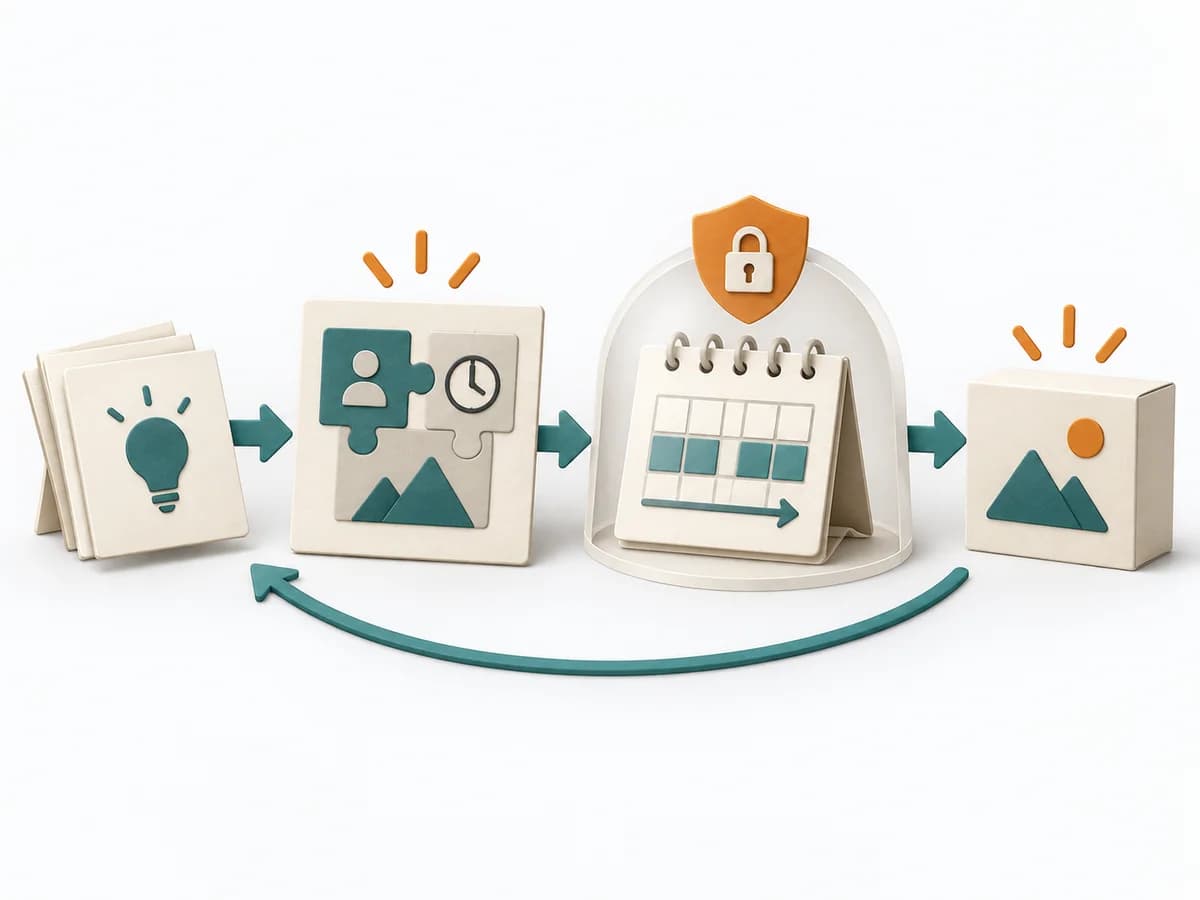 Delivery Shape Up |  Decision Making Assumption Surfacing |  Architecture LASR (Lightweight Approach for Software Reviews) |  Decision Making Pre-Mortem |
|---|---|---|---|---|
Purposedifferent | Shape Up helps clarify scope, sequence, and delivery flow. It makes work boundaries and decisions explicit and captures results as pitches, bet-table decisions, and hill charts. | Plans often contain assumptions that were never openly stated and remain dangerous precisely because of that. Assumption Surfacing makes these silent premises visible and prioritizes which of them carry the initiative or could sink it. | LASR helps development teams identify where their software falls short of important quality goals and which improvements to consider. A small group with existing system knowledge can make an initial assessment and investigate open questions in more detail. | In early initiatives with many uncertainties, planning quickly turns too optimistic. A pre-mortem makes the expected failure visible in advance and sharpens the view of causes, gaps, and countermeasures. |
Complexitydifferent | Medium | Low | Medium | Low |
Timedifferent | 6 Wochen Cycle + 2 Wochen Cool-Down | 45-90 min | 3–4 h for initial assessment; preparation and deeper analysis additional | 20–45 min |
Participantsdifferent | 2-4 pro Pitch | 2-8 | 1 or a small team; particularly suitable for 3–4 people | Small cross-functional group |
Formatdifferent | Workshop + async | Workshop + async | Workshop + async | Workshop |
Outputdifferent | Pitches, Bet-table decisions, Hill charts, Cooldown outcomes | Assumption List, Critical Assumptions, Learning Plan | Lean Mission Statement describing the software’s purpose, Prioritized quality goals and evaluation criteria, Risks and estimated gaps against quality goals, More closely examined findings and open checks | Risk list, Mitigation plan, Assumption log |
Tagsno overlap | PlanningDeliveryAutonomy | AssumptionsRiskDecisionDiscovery | ArchitectureQualityRiskAssessmentLean | RiskDecisionFailurePlanning |