View methods side by side.
Choose up to four methods. Add them using the search and share the comparison by copying its link.
| Criterion |  Business Strategy Porter Five Forces | 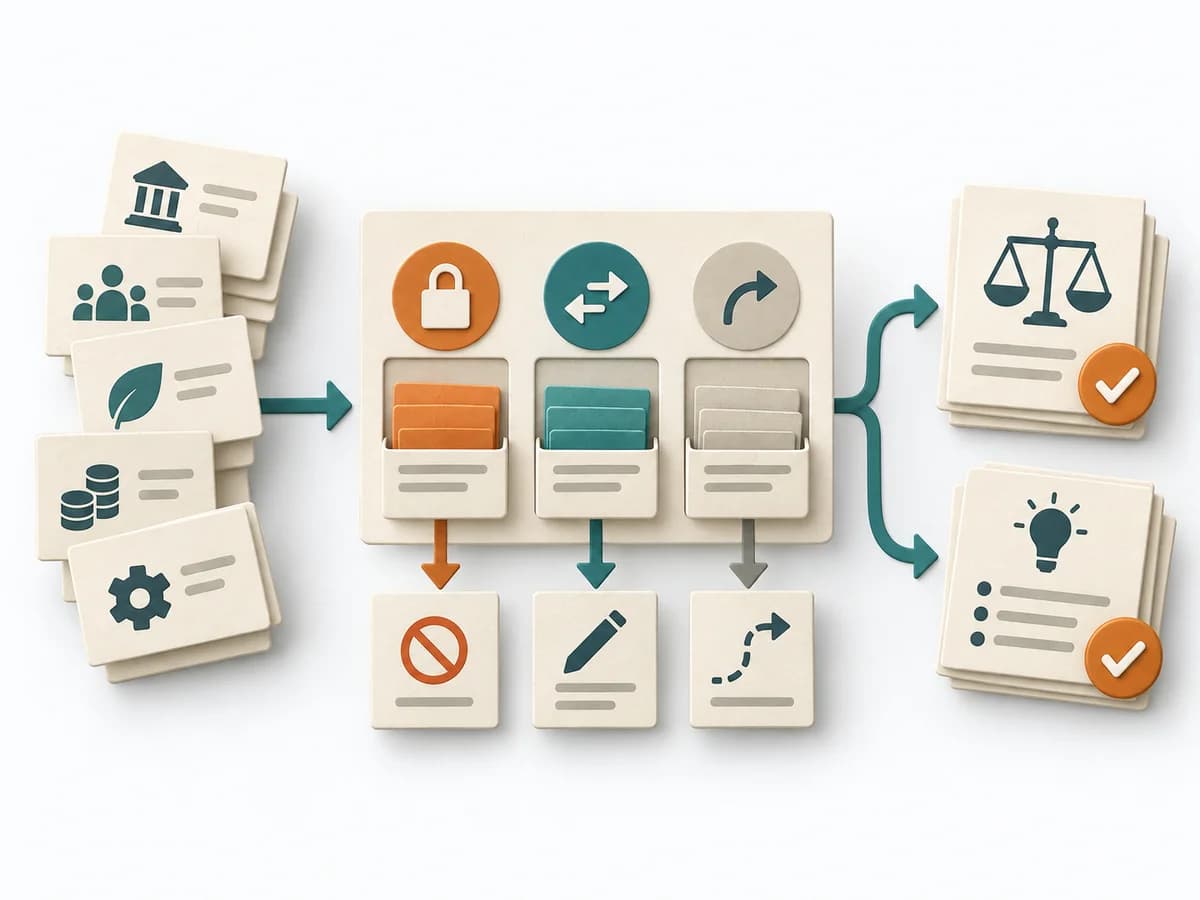 Decision Making Constraint Analysis |  Product Strategy DIBB |  Business Strategy Ansoff Matrix |
|---|---|---|---|---|
Purposedifferent | Porter Five Forces analyzes the forces that shape competitive pressure and profitability in a market. The view of market structure goes beyond individual competitors and reveals systemic pressure points. | When an initiative stalls, the limit often lies not in the idea but in hard or soft boundary conditions. Constraint Analysis separates these limits and shows which of them can actually be shaped. | DIBB helps clarify target groups, value, goals, and priorities by making the logic behind a decision explicit. It captures results as a DIBB document, belief list, bet list, and learning report. | The Ansoff Matrix organizes growth options by market and product relation. It helps weigh expansion, diversification, and adaptation cleanly against each other. |
Complexitydifferent | Medium | Low | Low | Low |
Timedifferent | 1-3 h | 30-90 min | 1-2 h | 45-90 min |
Participantssame | 2-8 | 2-8 | 2-8 | 2-8 |
Formatsame | Workshop + async | Workshop + async | Workshop + async | Workshop + async |
Outputdifferent | Five Forces Analysis, Competitive Risks, Strategic Options | Constraint List, Hard/Soft Classification, Option Impact Notes, Decision Boundaries | DIBB document, Belief list, Bet list, Learning report | Ansoff Matrix, Growth Options, Risk Notes |
Tagsno overlap | StrategyCompetitionMarket | ConstraintsDecisionPlanningOptions | StrategyDecisionAssumptionsHypothesis | GrowthStrategyMarketPortfolio |