View methods side by side.
Choose up to four methods. Add them using the search and share the comparison by copying its link.
| Criterion |  Knowledge Modeling PARA Method | 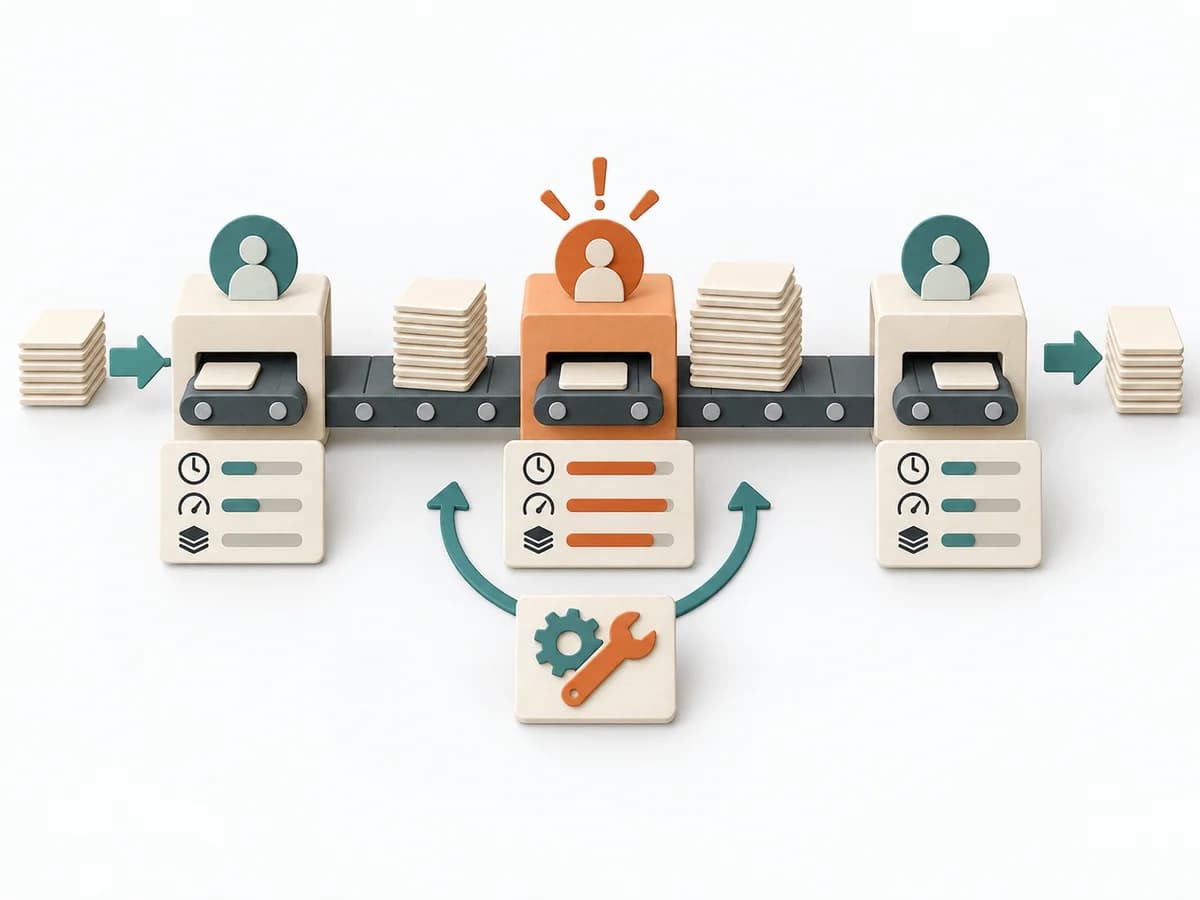 Operations Bottleneck Analysis |  Facilitation Six Thinking Hats |  Facilitation Decision Jam |
|---|---|---|---|---|
Purposedifferent | The PARA Method organizes knowledge into Projects, Areas, Resources, and Archives. It creates order when digital notes, files, and tasks no longer cleanly fit current work. | For a flow that backs up at one point, the method looks for the capacity limit with the greatest leverage. It explains why extra effort elsewhere barely improves throughput. | When a topic gets stuck too quickly in the same thinking mode, Six Thinking Hats deliberately separates the perspectives. This means facts, risks, creativity, and emotional signals get worked through one after another instead of mixed together. | When a decision is stuck, Decision Jam loosens the knot through structured separation of problem, idea, and selection. The format creates movement without jumping prematurely at the first seemingly elegant answer. |
Complexitydifferent | Medium | Medium | Medium | Low |
Timedifferent | 1-3 h Setup, laufend | 1-3 h | 45-90 min | 60-90 min |
Participantsdifferent | 1 | 3-8 | 4-12 | 4-10 |
Formatdifferent | Async | Workshop + async | Workshop | Workshop |
Outputdifferent | PARA Structure, Project Notes, Knowledge Archive | Bottleneck Map, Flow Metrics, Improvement Options, Follow-up Measures | Perspective Notes, Decision Inputs, Action Items | Problem Cluster, Prioritized Challenge, Experiment |
Tagsno overlap | KnowledgeProductivityOrganization | FlowMeasurementConstraints | FacilitationOptionsDecision | FacilitationDecisionProblem solvingWorkshop |