View methods side by side.
Choose up to four methods. Add them using the search and share the comparison by copying its link.
Selected:OODA LoopRequest for CommentsLASR (Lightweight Approach for Software Reviews)Force Field Analysis
| Criterion |  Decision Making OODA Loop | 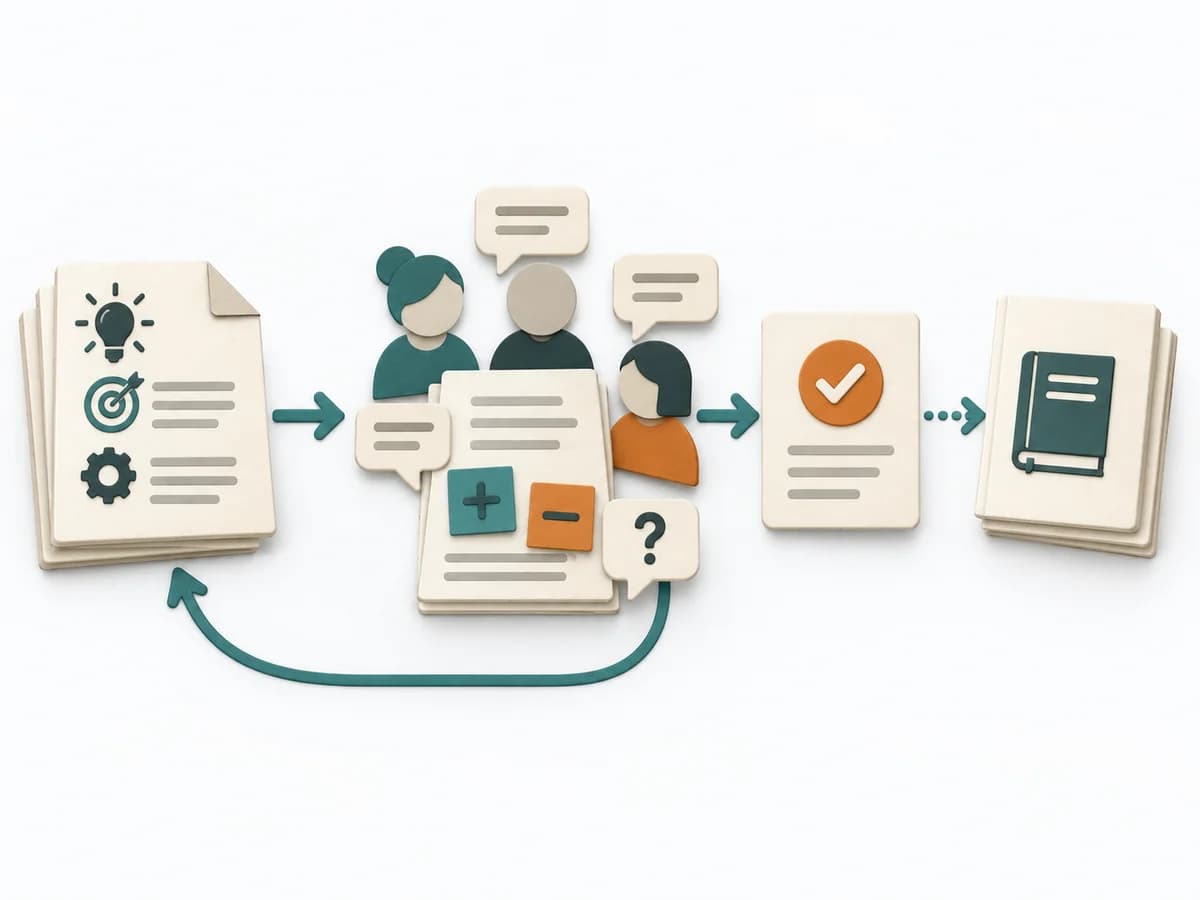 Architecture Request for Comments |  Architecture LASR (Lightweight Approach for Software Reviews) |  Decision Making Force Field Analysis |
|---|---|---|---|---|
Purposedifferent | In dynamic situations, decisions become outdated faster than they can be prepared. The OODA Loop holds observing, orienting, deciding, and acting together as a recurring rhythm so reaction does not slide into inertia. | An RFC clarifies architecture context, options, and consequences. It structures technical context, alternatives, tradeoffs, open questions, and review feedback, and captures the result as an RFC document, reviewer comments, and a decision rationale. | LASR helps development teams identify where their software falls short of important quality goals and which improvements to consider. A small group with existing system knowledge can make an initial assessment and investigate open questions in more detail. | In change initiatives, supporting and restraining forces sit at the table at the same time. Force Field Analysis makes these tensions explicit and shows where change can be pushed forward by strengthening or relieving. |
Complexitydifferent | Medium | Medium | Medium | Low |
Timedifferent | 15-60 min je Zyklus | 1-3 Wochen vom Draft bis zur Entscheidung | 3–4 h for initial assessment; preparation and deeper analysis additional | 45-90 min |
Participantsdifferent | 1-8 | 3-20 Reviewer | 1 or a small team; particularly suitable for 3–4 people | 3-12 |
Formatdifferent | Workshop + async | Async | Workshop + async | Workshop |
Outputdifferent | Situation Assessment, Decision Loop, Action Updates | RFC document, Reviewer comments, Decision rationale, Follow-up ADR or tickets | Lean Mission Statement describing the software’s purpose, Prioritized quality goals and evaluation criteria, Risks and estimated gaps against quality goals, More closely examined findings and open checks | Force Field Map, Change Levers, Risk Notes |
Tagsno overlap | DecisionChangeLearningStrategy | ArchitectureDecisionAsyncGovernance | ArchitectureQualityRiskAssessmentLean | ChangeDecisionStrategy |