View methods side by side.
Choose up to four methods. Add them using the search and share the comparison by copying its link.
| Criterion |  Product Discovery Outcome-Driven Innovation |  Innovation Design Thinking | 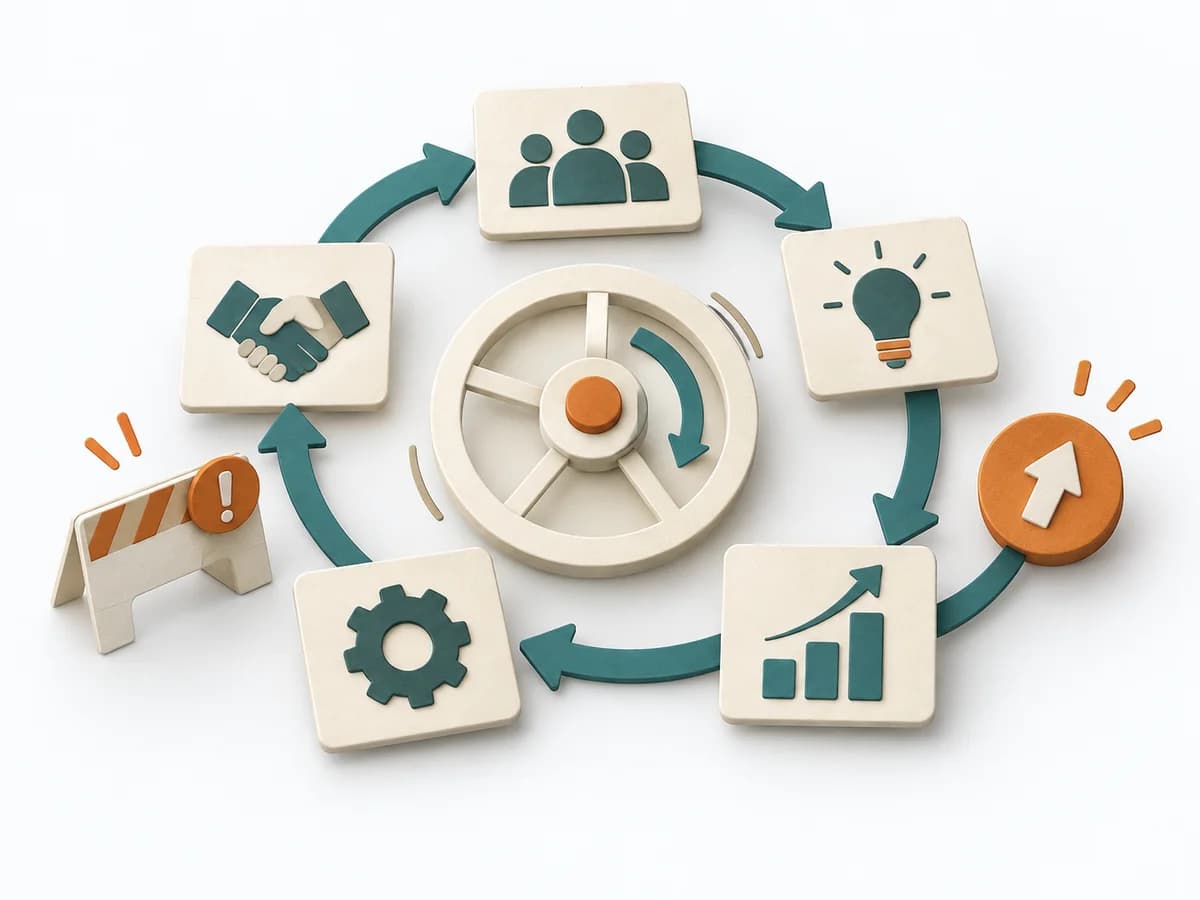 Growth Flywheel |  Growth North Star Metric |
|---|---|---|---|---|
Purposedifferent | Outcome-Driven Innovation clarifies customer problems, solution opportunities, and evidence. It separates jobs, desired outcomes, importance, satisfaction, and opportunity, and captures results as desired outcome statements, an opportunity landscape, and segments by underserved needs. | For complex user problems with an uncertain cause, the method connects observation, interpretation, and experiment into a learning cycle. It keeps the focus on real needs and avoids premature solution language. This produces robust decisions for product and service. | Growth often breaks down where a reinforcing mechanism builds up too much friction. A Flywheel shows the cycle of value, repetition, and reinforcement meant to sustain growth. | When product teams track many metrics, the view of the actual customer outcome easily gets lost. A North Star Metric bundles growth, usage, and value contribution into one signal that makes the system's direction visible. |
Complexitydifferent | High | High | Medium | Medium |
Timedifferent | Mehrere Wochen | 1 Tag bis mehrere Wochen | 60-120 min | 1-2 h |
Participantsdifferent | 2-6 researchers plus sample | 4-10 | 3-8 | 3-8 |
Formatdifferent | Workshop + async | Workshop | Workshop | Workshop + async |
Outputdifferent | Desired outcome statements, Opportunity landscape, Segmentation by underserved needs, Innovation hypotheses | Problem Statement, Prototype, Test Learnings | Flywheel Map, Friction Points, Growth Levers, Experiment Backlog | North Star metric, Input metric tree, Measurement cadence |
Tagsno overlap | OutcomesInnovationResearchQuantitative | InnovationPrototypeResearch | GrowthRetentionConversion | GrowthMetricsAlignmentRetention |