View methods side by side.
Choose up to four methods. Add them using the search and share the comparison by copying its link.
| Criterion |  Systems Thinking Leverage Points |  Innovation Design Sprint | 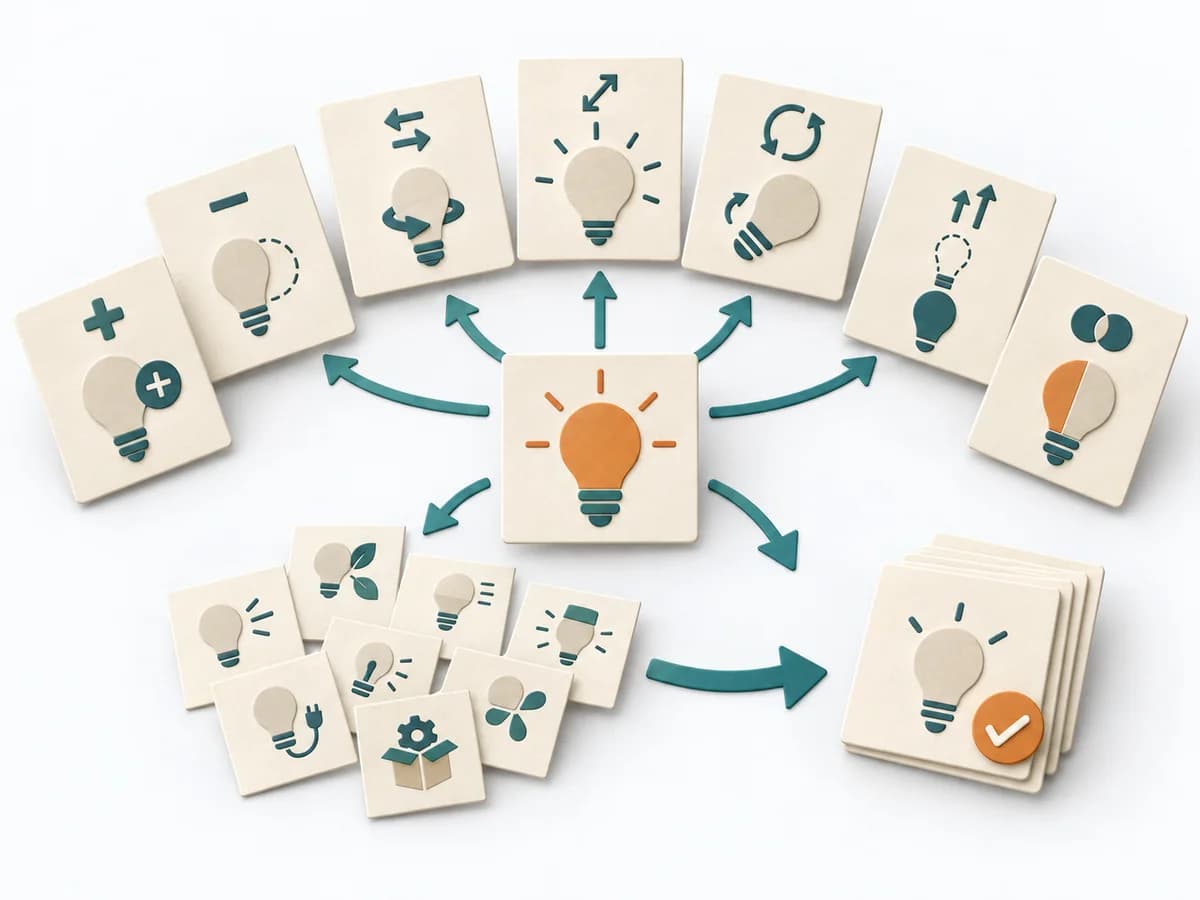 Innovation SCAMPER |  Innovation Brainstorming |
|---|---|---|---|---|
Purposedifferent | Leverage Points show exactly where interventions in a system produce a disproportionate effect. It draws relationships, patterns, and feedback loops. The result is captured as a leverage map and action strategy. | When the product question is unclear and time pressure is high, the method takes a team from an open idea to a testable solution. It connects problem understanding, decision, and learning in one compact format, lowering the risk of spending a lot of energy on a mere guess. | For an existing solution under pressure to change, the method deliberately opens space for systematic variants. It directs attention to rebuilding, combining, and repurposing rather than only new basic ideas. This produces concrete evolution paths for products, offerings, or workflows. | When a team faces an open question with many obvious directions, the method first creates breadth instead of premature commitment. It separates idea flow from evaluation and makes lines of thought visible, creating a pool for selection and further development. |
Complexitydifferent | High | High | Low | Low |
Timedifferent | Half day | 4-5 Tage | 30-60 min | 30-60 min |
Participantsdifferent | 3-12 | 5-8 | 2-10 | 4-12 |
Formatsame | Workshop | Workshop | Workshop | Workshop |
Outputdifferent | Leverage Map, Action Strategy | Prototype, Test Findings, Decision Rationale | SCAMPER Idea List, Concept Shortlist, Variation Notes | Idea pool, Theme clusters, Shortlist |
Tagsno overlap | Systems thinkingChangeStrategy | Design sprintPrototypeValidationInnovation | BrainstormingIdeationCreativityReframingInnovation | BrainstormingIdeationCreativityWorkshopDivergence |