View methods side by side.
Choose up to four methods. Add them using the search and share the comparison by copying its link.
Selected:Failure Scenario AnalysisArchitecture Decision Record8D Problem SolvingFailure Mode and Effects Analysis
| Criterion |  Engineering Failure Scenario Analysis |  Architecture Architecture Decision Record | 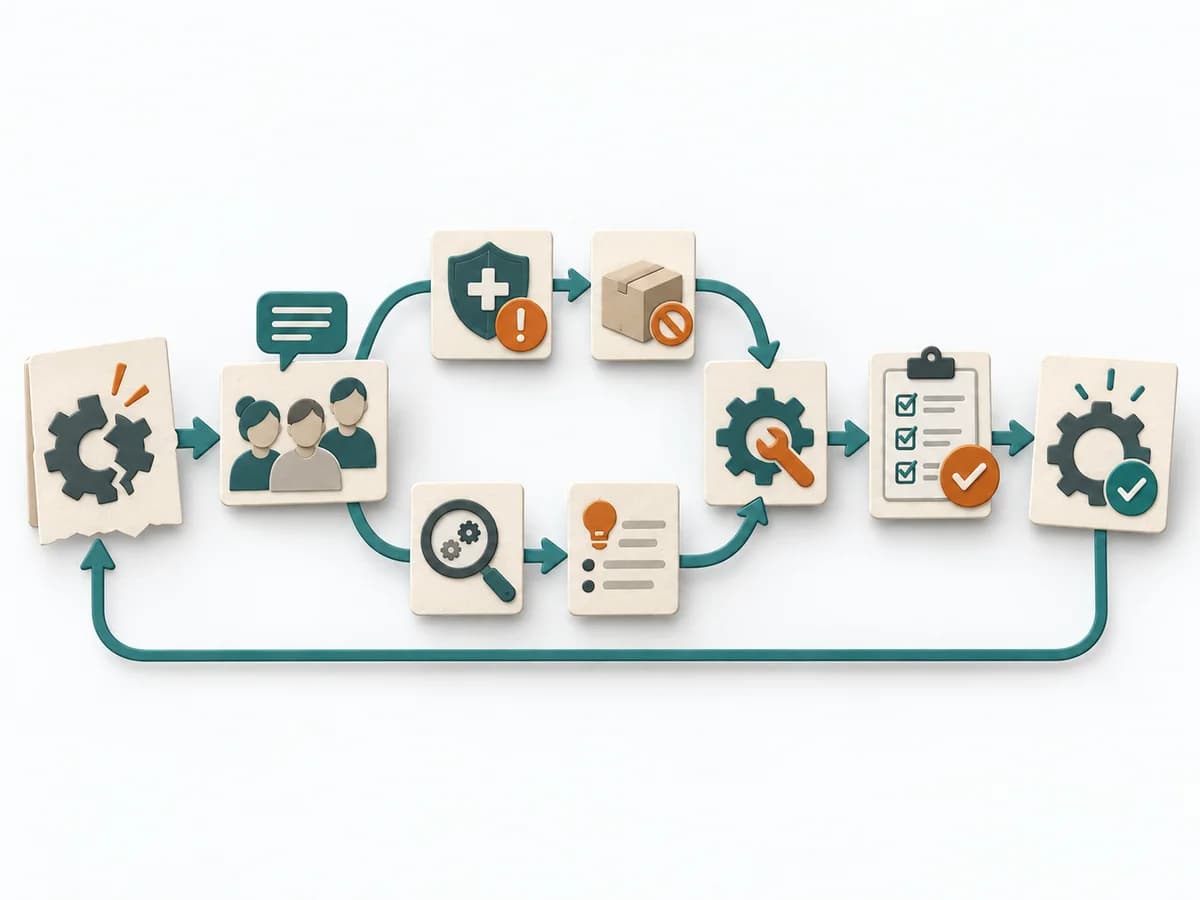 Operations 8D Problem Solving |  Operations Failure Mode and Effects Analysis |
|---|---|---|---|---|
Purposedifferent | In critical processes, it is not enough to plan only for the normal case. Failure Scenario Analysis looks at the path into failure and shows which failures, chains, and control gaps cause the most damage. | An ADR permanently records an architecture decision with context, trade-offs, and consequence. It creates continuity for later changes because the decision path stays traceable. | For an acute quality or delivery problem, the method structures immediate protection and root cause work together. It keeps the situation stable while the actual cause is investigated cleanly. | For a process, product, or service with noticeable failure risks, the method assesses possible failure modes in advance. It directs attention to combinations of occurrence, effect, and detectability. |
Complexitydifferent | Medium | Low | High | High |
Timedifferent | 1-3 h | 15-45 min | 1-6 Wochen | 2-6 h |
Participantsdifferent | 3-8 | 1-3 | 4-10 | 3-10 |
Formatdifferent | Workshop | Async | Workshop + async | Workshop |
Outputdifferent | Failure Scenarios, Risk Notes, Control Gaps, Test and Response Actions | ADR File, Decision Log, Rationale | 8D Report, Containment Plan, Root Cause Evidence, Corrective Action Plan | FMEA Table, Risk Priority, Mitigation Actions |
Tagsno overlap | FailureResilienceRisk | ArchitectureRationaleDocumentationGovernance | QualityProblem solvingRoot cause | RiskQualityOperationsRoot cause |