View methods side by side.
Choose up to four methods. Add them using the search and share the comparison by copying its link.
| Criterion |  Knowledge Modeling Domain Storytelling | 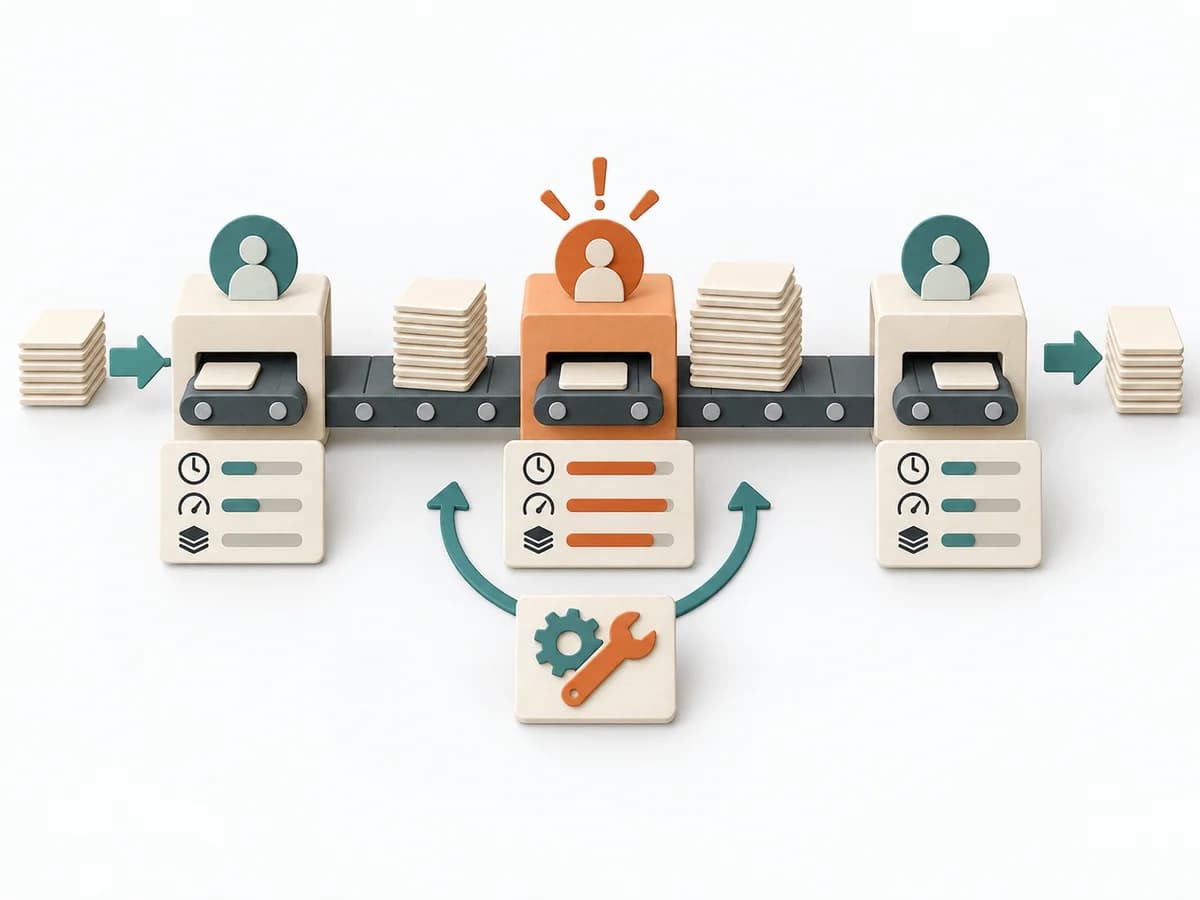 Operations Bottleneck Analysis |  Engineering Failure Scenario Analysis |  Knowledge Modeling Knowledge Mapping |
|---|---|---|---|---|
Purposedifferent | Domain Storytelling translates domain knowledge into a shared narrative of actors, objects, and workflows. It is especially useful when language, rules, and process understanding must be tightly connected. | For a flow that backs up at one point, the method looks for the capacity limit with the greatest leverage. It explains why extra effort elsewhere barely improves throughput. | In critical processes, it is not enough to plan only for the normal case. Failure Scenario Analysis looks at the path into failure and shows which failures, chains, and control gaps cause the most damage. | Knowledge Mapping makes knowledge, gaps, and transfer paths visible across a field. It fits when expertise should not just exist but also be findable and transferable. |
Complexitydifferent | Low | Medium | Medium | Medium |
Timedifferent | 1-2 h | 1-3 h | 1-3 h | 1-3 h |
Participantsdifferent | 2-8 | 3-8 | 3-8 | 3-12 |
Formatdifferent | Workshop | Workshop + async | Workshop | Workshop |
Outputdifferent | Domain Story, Glossary Notes, Process Narrative | Bottleneck Map, Flow Metrics, Improvement Options, Follow-up Measures | Failure Scenarios, Risk Notes, Control Gaps, Test and Response Actions | Knowledge Map, Critical Knowledge Areas, Transfer Plan |
Tagsno overlap | KnowledgeDomain-Driven DesignProcess | FlowMeasurementConstraints | FailureResilienceRisk | KnowledgeMappingRisk |