View methods side by side.
Choose up to four methods. Add them using the search and share the comparison by copying its link.
| Criterion |  Facilitation Alignment Mapping |  Facilitation Stakeholder Salience Model |  Innovation SCAMPER | 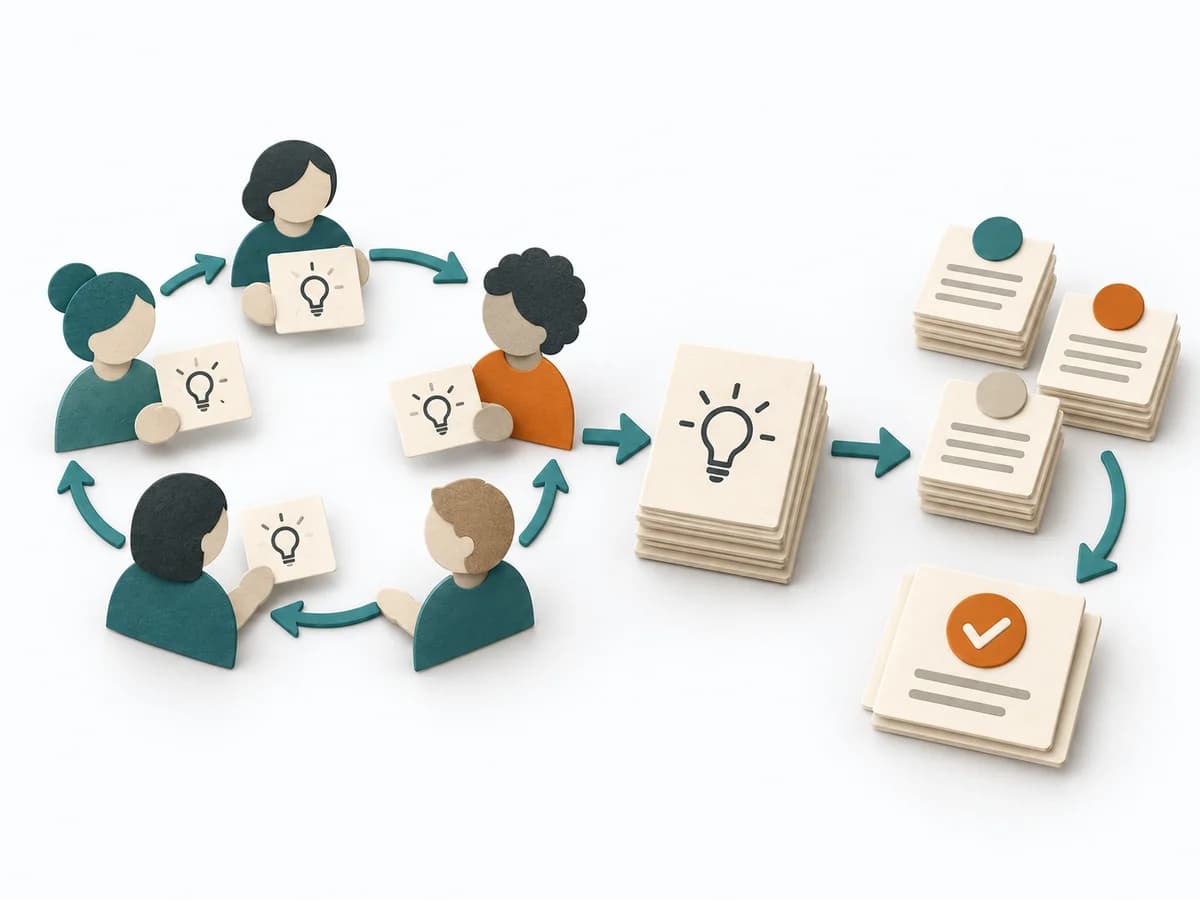 Innovation Round Robin Brainstorming |
|---|---|---|---|---|
Purposedifferent | When several people work toward one goal but hold different mental maps, Alignment Mapping makes the discrepancies visible. It arranges goals, assumptions, and priorities so shared direction becomes verifiable. | When stakeholders appear to matter very differently, the Stakeholder Salience Model rates their actual priority through power, legitimacy, and urgency. It turns individual contributions into a visible selection. The result is captured as a Salience diagram and a class-based strategy. | For an existing solution under pressure to change, the method deliberately opens space for systematic variants. It directs attention to rebuilding, combining, and repurposing rather than only new basic ideas. This produces concrete evolution paths for products, offerings, or workflows. | With unevenly distributed speaking time, the method brings every person into the contribution one after another. It prevents early voices from setting the direction while still producing a shared idea space. This makes participation plannable and the team's diversity visible. |
Complexitydifferent | Medium | Medium | Low | Low |
Timedifferent | 1-2 h | 60-90 min | 30-60 min | 20-45 min |
Participantsdifferent | 4-12 | 3-6 | 2-10 | 4-10 |
Formatsame | Workshop | Workshop | Workshop | Workshop |
Outputdifferent | Alignment Map, Open Issues, Decision Questions | Salience Diagram, Strategy per Class | SCAMPER Idea List, Concept Shortlist, Variation Notes | Idea List, Cluster, Shortlist |
Tagsno overlap | AlignmentStakeholdersStrategyFacilitation | StakeholdersFacilitationAlignmentGovernance | BrainstormingIdeationCreativityReframingInnovation | BrainstormingIdeationFacilitationInclusionCreativity |