View methods side by side.
Choose up to four methods. Add them using the search and share the comparison by copying its link.
| Criterion |  UX Research Affinity Diagramming | 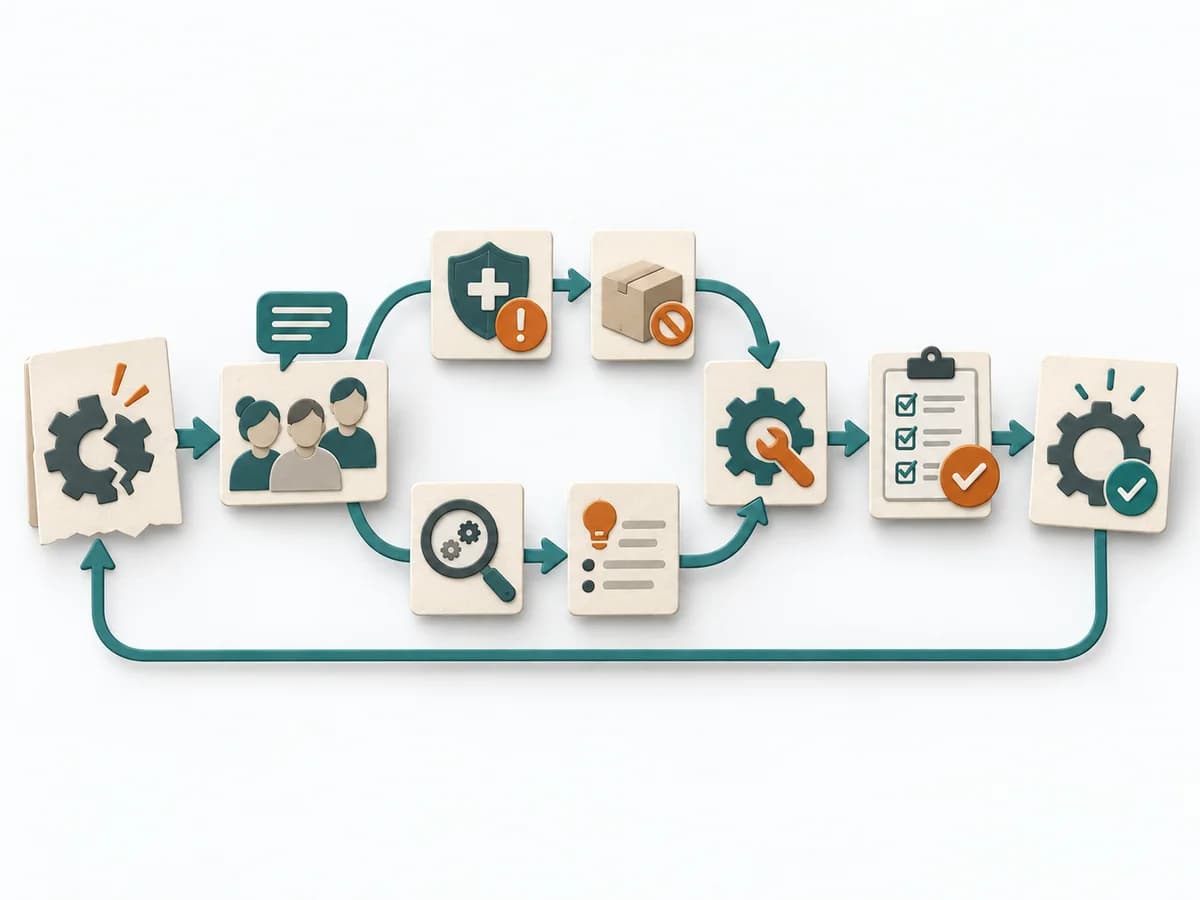 Operations 8D Problem Solving |  Innovation Design Thinking |  Operations Root Cause Analysis |
|---|---|---|---|---|
Purposedifferent | When research notes, feedback, or observations sit unconnected side by side, affinity diagramming sorts the raw material into solid themes. Many individual points turn into patterns that make decisions and opportunities clearer. | For an acute quality or delivery problem, the method structures immediate protection and root cause work together. It keeps the situation stable while the actual cause is investigated cleanly. | For complex user problems with an uncertain cause, the method connects observation, interpretation, and experiment into a learning cycle. It keeps the focus on real needs and avoids premature solution language. This produces robust decisions for product and service. | When a problem keeps recurring and the cause stays unclear, the method exposes the underlying mechanism. It separates symptom, guess, and robust explanation from one another. |
Complexitydifferent | Low | High | High | Medium |
Timedifferent | 45–90 min | 1-6 Wochen | 1 Tag bis mehrere Wochen | 1-4 h |
Participantsdifferent | 3-10 | 4-10 | 4-10 | 3-8 |
Formatdifferent | Workshop | Workshop + async | Workshop | Workshop + async |
Outputdifferent | Theme clusters, Insight statements, Opportunity areas | 8D Report, Containment Plan, Root Cause Evidence, Corrective Action Plan | Problem Statement, Prototype, Test Learnings | Problem Statement, Cause Hypotheses, Confirmed Causes, Action Plan |
Tagsno overlap | SynthesisQualitativeRoot cause | QualityProblem solvingRoot cause | InnovationPrototypeResearch | Root causeProblem solvingQualityIncident |