View methods side by side.
Choose up to four methods. Add them using the search and share the comparison by copying its link.
| Criterion | 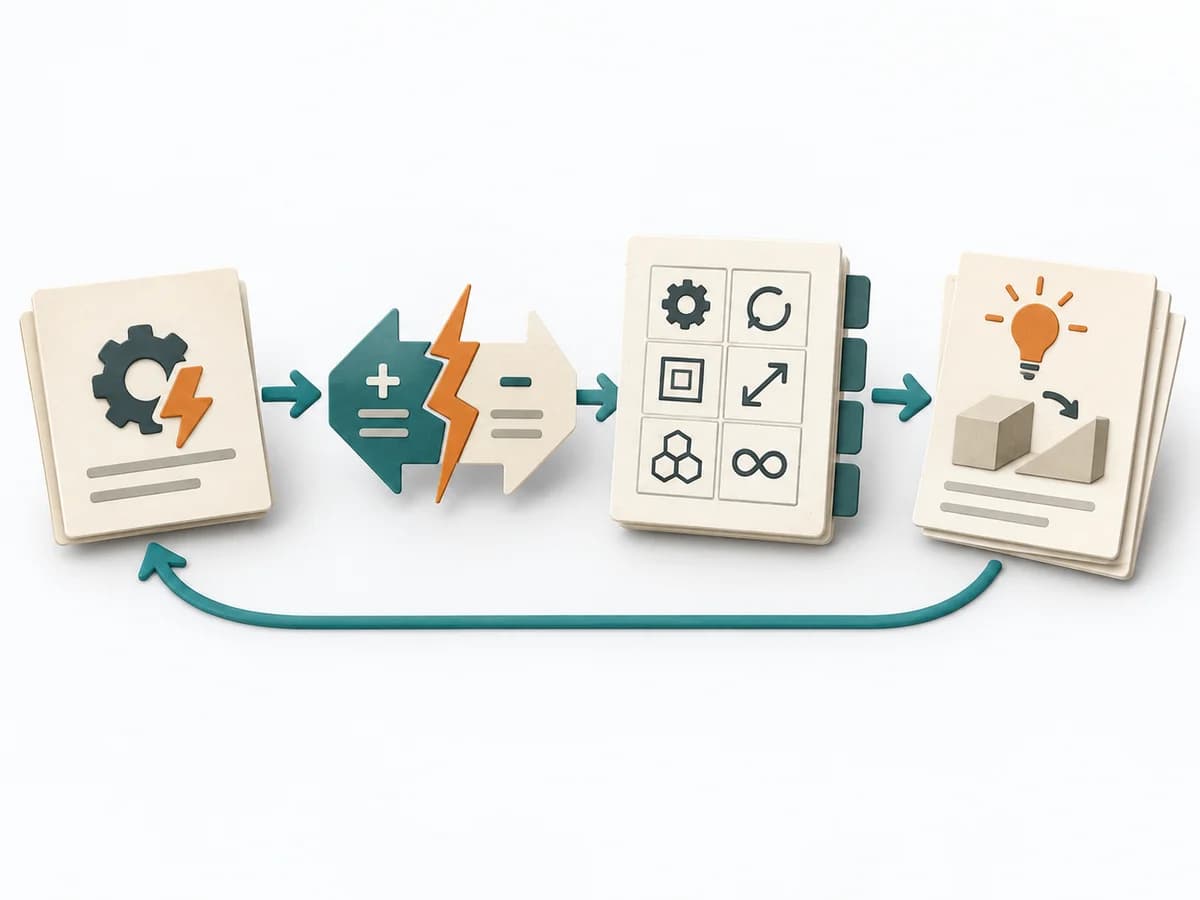 Innovation TRIZ |  UX Research Card Sorting |  Innovation Double Diamond |  Innovation Brainstorming |
|---|---|---|---|---|
Purposedifferent | For technical contradictions or trade-offs, the method looks for solutions that resolve opposing requirements at the same time. It translates limits into an explicit picture of conflict that becomes workable. This produces not just compromises but more elegant principles. | When content only makes sense internally and users can't find the structure again, card sorting exposes their mental order. Terms, groups, and naming are then aligned with the target group's expectations. | For complex problems with a fuzzy situation, the method cleanly separates search space and decision. It first creates breadth in understanding and then focus in elaboration. This brings open questions, problem definition, and solution path into a traceable movement. | When a team faces an open question with many obvious directions, the method first creates breadth instead of premature commitment. It separates idea flow from evaluation and makes lines of thought visible, creating a pool for selection and further development. |
Complexitydifferent | High | Low | Medium | Low |
Timedifferent | 1-4 h | 20-45 min | Wochen bis Monate | 30-60 min |
Participantsdifferent | 2-8 | Based on research question | 3-12 | 4-12 |
Formatdifferent | Workshop + async | Workshop + async | Workshop + async | Workshop |
Outputdifferent | Contradiction Statement, Inventive Principles, Solution Concepts | Content groups, Label set, IA hypotheses | Problem Statement, Solution Options, Prototypes, Deliverables per Phase | Idea pool, Theme clusters, Shortlist |
Tagsno overlap | InnovationProblem solvingContradictionsCreativity | Information architectureNavigationStructure | ProcessDivergenceInnovation | BrainstormingIdeationCreativityWorkshopDivergence |